If you have searched for ways to practise situational judgement tests, most of what you will find is written, multiple-choice material built for graduate schemes. It is useful for learning how judgement is assessed. It does not match what Police Scotland asks you to do.
The Police Scotland situational judgement exercise lasts 60 minutes, and the scenarios are delivered verbally to a group. You get no reading time. You are then questioned individually about your considerations and your intended actions, and your performance is marked against the Competency and Values Framework (CVF). Reaching the required standard is what takes you forward to interview.
This guide does two things. It explains the generic SJT principles that are worth learning, including how ranking and rating formats work. Then it shows you how to adapt that preparation to a reactive, spoken exercise, with three original practice scenarios you can rehearse out loud.
What a situational judgement test actually is

A situational judgement test is a pre-employment assessment that presents a realistic work-related scenario and asks you to choose, rank or rate the possible responses. The scenarios are not random. They are drawn from situations someone in that role is likely to face, which is why an SJT also gives you a preview of the job.
What is being measured is judgement, not knowledge. An SJT sits apart from a cognitive ability test because it is not trying to time your logic or your memory. It looks at behavioural decision-making: how you interpret a situation, how you prioritise, and what you actually do about it. In practice that means your behavioural tendency under pressure, expressed through a choice you can defend.
The design varies by employer and by role. Some assessments are timed and others allow unlimited completion time, and the number of questions can range anywhere from 18 to over 70 across different publishers. That variation is precisely why generic advice about “the” SJT format is unreliable. Read the instructions you are given on the day and follow those.
Scoring varies too. Generic SJT guidance does not establish a universal pass mark, because the preferred answers are the ones that align with the employer’s values and the demands of the role. Where percentile benchmarks are used, a good score is generally considered to be in the 70th to 80th percentile band. Police Scotland’s exercise does not work on a published percentile; it has a required standard for progression, judged against the CVF.
It also helps to know where an SJT sits next to the other assessments you may meet during recruitment.
| Assessment | Strength | Best For |
|---|---|---|
| SJT | Contextual behaviour analysis | Interpersonal and judgement-heavy roles |
| Cognitive ability test | Speed, logic, memory | Analytical and data-driven jobs |
| Personality test | Traits and motivations | Culture fit and development planning |
| Hard skills test | Demonstrated expertise | Technical and operational roles |
One point of terminology before we go further. The PSET is Police Scotland’s written entrance test and it is a separate stage with its own rules. Keep its vocabulary and its timings out of your thinking about the situational judgement exercise. Mixing the two is one of the quickest ways to prepare for the wrong thing.
How ranking and rating formats are scored
Most written practice material asks you to rate each response for effectiveness, to rank the options from best to worst, or to pick the most and least effective. Understanding how those keys work tells you a lot about what assessors are really looking for, even when your own exercise is spoken.
Take a simple retail prompt used in published practice material. You are restocking an aisle and cannot leave the stock unattended when a customer asks for help finding a product. Four responses are offered, and the published key records them like this.
| Option | Rank |
|---|---|
| a) You explain to the customer that you cannot leave the stock unattended. You tell them the aisle number but do not walk with them to the aisle. | 3 |
| b) You apologise to the customer and explain to them that you cannot leave the stock unattended so you cannot help them. | 1 |
| c) You apologise to the customer and explain that you cannot leave the stock unattended. You ask the customer to find another colleague to help them. | 4 |
| d) You apologise to the customer explain to them that you cannot leave the stock unattended. You ask another colleague in your aisle to help the customer. | 2 |
Look at how little separates these options. Every one of them acknowledges the same constraint. The differences are in who ends up carrying the effort and whether the person in front of you is left with a solution. Workplace scenarios in SJTs are usually built this way, with narrow gaps between plausible answers, because that is where judgement shows.
Scoring keys then reward near misses rather than demanding a perfect match. A published Dental Foundation Training situational judgement paper illustrates the arithmetic clearly. The ideal rank for one item is DCEAB, worth 20 marks in full. An answer of DABEC scores 12, because partial credit is awarded according to how far each option sits from its ideal position.
| Ideal rank | Applicant rank 1 | Applicant rank 2 | Applicant rank 3 | Applicant rank 4 | Applicant rank 5 |
|---|---|---|---|---|---|
| D | 4 | 3 | 2 | 1 | 0 |
| C | 3 | 4 | 3 | 2 | 1 |
| E | 2 | 3 | 4 | 3 | 2 |
| A | 1 | 2 | 3 | 4 | 3 |
| B | 0 | 1 | 2 | 3 | 4 |
The practical lesson carries across formats. You are rarely penalised for a response that is reasonable but not optimal. You lose ground when you place a clearly weak action near the top, or push a genuinely effective one to the bottom. In a spoken exercise, the equivalent mistake is leading with a minor administrative step while saying nothing about immediate safety.
How the Police Scotland exercise differs from a written SJT
Police Scotland runs a 60-minute situational judgement exercise in which unfolding hypothetical policing scenarios are presented verbally to the group. Each candidate is then asked individually about their considerations and their intended actions.
The exercise is reactive. There is no reading time, so you cannot scan the prompt, draft an answer and polish it before committing. You hear the situation, the situation develops, and you respond. This is the single biggest reason that written practice alone leaves candidates underprepared: the thinking is similar, but the delivery is nothing alike.
It is also not a written multiple-choice SJT. You are not selecting from a list, so there is no key to work backwards from and no option to eliminate. You are explaining a course of action and the reasoning behind it, in your own words, to an assessor who will mark what you say against the CVF.
Because the exercise is required to reach the interview stage, treat it as a gate rather than a formality. A candidate who does not meet the standard does not progress at that point, whatever the strength of the rest of the application.
Group delivery adds a further demand. Scenarios are presented to everyone at once, but accountability is individual. You need to stay engaged while others are speaking, hold the facts of the unfolding scenario in your head, and be ready to give a structured answer when the question comes to you.
What the exercise is assessing
The core competencies that SJTs explore are consistent across employers: problem-solving, communication, teamwork, ethical judgement, adaptability and decision-making under pressure. Police Scotland assesses those qualities through the CVF, so your reasoning needs to be visible rather than implied.
Scale explains why judgement matters so much here. Police Scotland reports receiving over three million contacts a year, including over four thousand 101 non-emergency calls daily and two thousand 999 emergency calls daily, handled through three Area Control Rooms. The service covers 28,168 square miles with a workforce of 23,000 officers and staff, according to its official MyJobScotland profile. Demand like that means officers are constantly weighing what must happen now against what can wait.
Three themes repay attention when you prepare. Prioritisation, because competing demands are normal rather than exceptional. Communication, because most of what an officer does involves explaining decisions to people who did not choose to be involved. Integrity, because the easiest shortcut is often the one with the worst consequences later.
A word of caution on the CVF. Use the framework as a guide to the behaviours that matter, and learn how it describes public service, professionalism and effective decision-making. Do not invent a scorecard, and do not try to recite competency labels in your answers. Assessors are listening for judgement in plain language, not for keywords.
A spoken framework for answering

You need a scaffold you can run in your head in a few seconds, because you will have no notes and no preparation time. A simple sequence works: state the issue, set your immediate priorities, weigh the realistic options, give your intended action and the reason for it, then say who you would tell and what you would review.
Start by restating the immediate problem in one sentence. This buys you a moment, confirms you heard the scenario correctly, and forces you to separate the urgent issue from the background detail.
Name your priorities next, in order. Safety of any person at risk comes first, then preserving information and evidence, then the wider task. If the scenario has shifted since it began, say so explicitly: recognising that priorities have changed is itself part of the judgement being assessed.
Then commit. Give the action you would take, say briefly why, and acknowledge the option you rejected and the reason. Answers that list every possible response without choosing one sound thorough but read as indecision.
Finish with communication and review. Who needs to know, what you would record, and what you would check afterwards. Short and specific beats long and vague.
Two constraints are worth holding on to. Use only the information you have been given and avoid importing assumptions that were never stated. And match the action to the authority of the role: a response that requires disproportionate senior involvement does not suit a probationary constable, while a response that quietly absorbs a serious risk on your own is just as misjudged.
One habit to leave at the door is the STAR method. STAR is built for competency interviews, where you evidence a past example with situation, task, action and result. The situational judgement exercise asks what you would do in a hypothetical scenario happening now. Starting a STAR answer here costs you time and answers a question nobody asked. Save the STAR method for the interview stage, where it belongs.
Practice scenario 1: competing demands and public safety
The prompts below are original and fictional. They are written to rehearse reasoning, not to reproduce live test content, and no published answer key exists for them.
Scenario. You are on patrol. A report comes in of an older man with a diagnosed memory condition who has not returned home after several hours, last seen near a river path. At almost the same moment, you are asked about a report of a damaged shopfront nearby where the owner is waiting on site. A moment later, a further detail arrives: the missing man was reportedly seen in a distressed state twenty minutes ago.
What to establish aloud. Say what you would want to know first and why. Where exactly was the man last seen, who saw him, what is the risk from the location, and who else is already looking. For the shopfront, establish whether anyone is injured, whether the suspect is still present, and whether the damage creates an ongoing hazard.
How to compare the two. Make the comparison explicit rather than leaving it implied. The missing man carries an immediate risk to life, the location raises that risk further, and the new sighting makes the information time-critical. The shopfront involves property with the owner safe and present, so it can be attended shortly without the same risk escalating.
Your intended action. Prioritise the search, request that the shopfront report is passed for a response that keeps the owner updated, and explain what you would do as you travel. Say what you would communicate, including any update to colleagues about the latest sighting.
Where candidates lose marks. Trying to do both at once without choosing. Giving a full answer on the property report and treating the missing person as background. Or deciding correctly but never saying who you would update when the picture changed.
Practice scenario 2: communication, conflict and vulnerable people
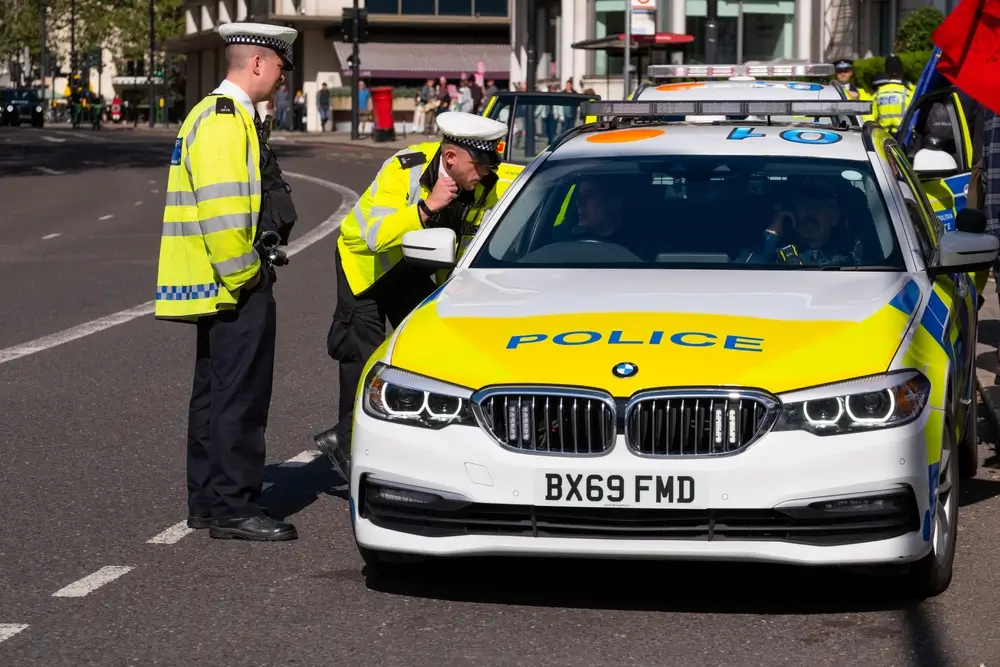
Scenario. You arrive at a flat following a noise complaint. A woman answers the door, visibly upset and tearful. She says she is fine and wants you to leave. Through the doorway you can see a young child awake and a mobile phone on the floor with a cracked screen. Your colleague, who is more experienced than you, says loudly that the call is a waste of time and starts walking back to the vehicle.
On the member of the public. Explain your interpersonal approach and your practical action, not just your feelings. Slow the conversation down, speak calmly, give her space away from the doorway if possible, and ask open questions about who is in the flat and whether anyone needs help. Say what you would be looking for and why the child’s presence changes your threshold for leaving.
On the colleague. Disagreement with a colleague is a judgement test in itself. The reasonable response is a calm, private conversation rather than a confrontation in front of the public: ask for a moment, set out what you have seen, and explain why you want to continue. If the concern remains unresolved and someone may be at risk, say that you would seek advice from a supervisor rather than walk away.
The trap to avoid. Empathy is necessary but not sufficient. Answers that describe how sorry you would feel, without saying what you would establish, record or escalate, sound sincere and score poorly. State the approach and the action together.
Practice scenario 3: integrity, accountability and escalation
Scenario. At the end of a long shift, you notice that a record submitted earlier contains a detail that is wrong. It is not deliberate, and correcting it will take time that everyone would rather spend finishing up. A colleague suggests leaving it, on the basis that the error is minor and unlikely to matter.
How to answer. Start with accuracy. Say that the record needs to be correct because other people will rely on it, and explain what you would do to fix it and when. Then address the suggestion directly but respectfully: you can acknowledge the time pressure while being clear that you would not leave an inaccurate entry in place.
Raising the concern. Describe the proportionate route. Speak to the colleague first, correct the record, and tell a supervisor if the error has already been acted on or if it could affect someone else’s decision. Escalation is not about reporting people. It is about making sure the right person knows in time to act.
Keeping within what you know. Resist the urge to quote statute, force policy or procedure numbers you are not certain about. You are being assessed on judgement, not on recall of Scottish law, and a confident citation that turns out to be wrong undermines everything else you say. Describe what you would do and why it is the right thing to do.
How to practise for a reactive, verbal exercise
Practice works. It makes the format familiar, reduces the surprise of the first scenario, and shows you where your reasoning is thin. But what you practise has to match what you will be asked to do.
Build a voice-first routine. Ask someone to read you a scenario you have not seen, then answer out loud immediately with no notes and no second attempt. If you have nobody to read to you, record the prompt and play it back. The discomfort of answering cold is the point, because that discomfort is the exercise.
Use written SJT practice for the principles rather than the format. A written psychometric test teaches you how scenario logic works, how responses are compared, and how employer values shape the preferred answer. It cannot reproduce a verbal group-and-individual exercise with no reading time, so do not let it become the whole of your preparation.
Rehearse against the clock as well. Sixty minutes is long enough that concentration matters: scenarios develop, details accumulate, and a candidate who switches off between questions loses track. Practise staying attentive through several scenarios in a row, not just one.
Review your reasoning rather than your verdict. After each attempt, check whether you covered four things: what you prioritised, what you actually did, who you told, and what you would review. If one of those is routinely missing, that is your gap. Record yourself occasionally; most people discover they trail off at the end instead of finishing with a clear decision.
On the day: delivery and common mistakes
Listen all the way through before you start forming an answer. Scenarios unfold, and the detail that changes everything often arrives last. Candidates who decide early frequently find themselves defending a position the scenario has already overtaken.
Avoid a memorised script. A rehearsed opening is obvious within a sentence, and it rarely fits the situation you have just been given. Learn the scaffold, not the sentences.
Keep your answer structured and concise. Cover your considerations and your intended actions clearly, then stop. Filling silence with speculation adds risk without adding marks, and it tends to pull you into assumptions the scenario never supported.
Do not transfer written-test habits into a spoken room. There is no option list to eliminate, no chance to revisit an answer, and no benefit in hedging across every possibility. Decide, explain, and be willing to say what you would do differently if a specific detail turned out otherwise.
Finally, answer as a professional rather than as a private individual. You are describing what you should do in the role you are applying for, in a service where the public expects consistency.
Other public-sector SJTs are not the same exercise
Applicants often arrive having practised a DWP-style situational judgement test or the work-based scenarios used in the Civil Service Fast Stream, and ask how banding or a band 1 result translates here. It does not. Those recruitment processes are run by different employers, with their own assessment design and their own competency frameworks, such as the Civil Service Behaviours used elsewhere in UK public-sector hiring.
That material can still be useful for drilling the habits that transfer: reading a situation carefully, weighing options against stated values, and choosing an action you can justify. Treat the scoring systems, banding language and question counts as specific to those employers. For Police Scotland, the reference point is the CVF and the verbal format described above.
Before you apply: eligibility and the next step
It is worth confirming the basics before you invest weeks in preparation. Police Scotland states on its careers pages that you can apply to be a police officer if you are 18 or over, that you must have lived in the UK for at least three years immediately before applying, and that a manual driving licence is required. The residency and manual licence conditions are also set out in the official Police Scotland vacancy advert, and the three-year continuous residence rule applies to police staff roles as well.
Beyond the application, Police Scotland sets out what follows. Initial training runs for 18 weeks, made up of one week at a regional training centre, 15 weeks at the Scottish Police College or a Training and Recruitment Centre, and a further two weeks at a regional training centre. The probationary period lasts two years. The police constable vacancy published on MyJobScotland lists a pay range of £31,466.00 to £50,528.00.
If you are weighing up your route in, Police Scotland also runs a Youth Volunteer programme for people aged 13 to 17, and transferee opportunities open periodically. When last checked, the MyJobScotland transferee listing showed no active vacancies and a talent bank instead, so check current openings before planning around that route.
For the preparation itself, pair this guide with our Police Scotland recruitment hub and our CVF article, then practise aloud. The most effective routine is simple: one unseen prompt, one spoken answer, one honest review, repeated until the structure feels automatic. Start with the free PSET practice paper at https://www.jointhecops.co.uk/free-pset/ to cover the written entrance test, then switch to voice-first drills for the situational judgement exercise. This is an independent preparation resource and is not Police Scotland or the SPA.
Frequently Asked Questions
What is situational judgement?
Situational judgement is the ability to read a realistic work situation, weigh the possible responses and choose an effective course of action. Generic SJTs ask you to choose, rank or rate those responses in writing. The Police Scotland exercise applies the same principle through spoken policing scenarios that unfold as you listen, rather than a multiple-choice paper.
How is the Police Scotland situational judgement exercise different from a standard SJT?
It is a 60-minute verbal exercise. Unfolding hypothetical policing scenarios are presented to a group, and each candidate is then questioned individually about their considerations and intended actions. It is reactive, there is no reading time, it is not a written multiple-choice SJT, it is marked against the CVF, and reaching the required standard is necessary to progress to interview.
How long is the Police Scotland situational judgement exercise?
It lasts 60 minutes. That timing applies to the Police Scotland situational judgement exercise specifically. Do not substitute durations quoted for generic written SJTs, and do not confuse this exercise with the separate PSET entrance test.
How do you pass an online situational judgement test, and what should you do for Police Scotland?
For a written or online SJT, research the role and the employer’s values, identify the core issue in each scenario, use only the information provided, and practise with realistic prompts. For Police Scotland, adapt that preparation to a reactive verbal exercise: listen to the whole scenario, state your considerations and intended actions clearly, explain your reasoning, and stop treating it as a written multiple-choice task.
Can you provide an example of a Police Scotland situational judgement test scenario?
Use a clearly fictional prompt rather than a claimed live item. For instance, you hear two reports competing for attention, one involving a potentially vulnerable person and one involving a lower-risk concern. Explain what you would establish first, how you would prioritise immediate safety, what you would communicate and to whom, and what you would review afterwards. The aim is to demonstrate reasoning aloud, not to guess a published answer.
Is the Police Scotland situational judgement exercise hard?
It can feel demanding, mainly because the scenarios unfold verbally, there is no reading time, and you have to respond individually about your considerations and intended actions. Candidates who struggle are usually those who prepared only with written drills. Practise the speaking and listening demands and the difficulty drops considerably.
Where can I practise situational judgement tests for free?
Start with the free PSET practice paper linked in the section above, which covers the written entrance test. Combine it with voice-first practice for the situational judgement exercise, because generic written SJT material cannot reproduce its reactive verbal format. This platform is an independent preparation resource and is not affiliated with Police Scotland.
How should I study for a situational judgement exam?
Build a short, repeatable routine. Learn the role and the CVF context, practise realistic prompts, answer aloud with no preparation time, then review whether your explanation covered priorities, action, communication and follow-up. Use only the facts given in the scenario, and do not import assumptions or rules from another jurisdiction or another employer’s process.
Can you fail a situational judgement test for Police Scotland?
The Police Scotland exercise has a required standard for progression to interview. An applicant who does not meet that standard will not move forward at that stage. There is no published percentile to aim at, so preparation should focus on clear, role-relevant reasoning that lines up with the CVF.
Why is professional judgement important in policing?
Policing decisions are made quickly, in public, and often with incomplete information. Generic SJT material frames judgement as deciding how to act in realistic and sometimes ambiguous situations, drawing on problem-solving, communication, teamwork and ethical decision-making. The Police Scotland exercise asks you to make those considerations and intended actions explicit, so that your judgement can be assessed directly against the CVF.
Sources
Realistic mock exams in Language, Numeracy and Information Handling with complete explanations.
Special Constable Police Scotland: Role, Eligibility, Process
Police Officer in Scotland: The Police Constable Role Explained