
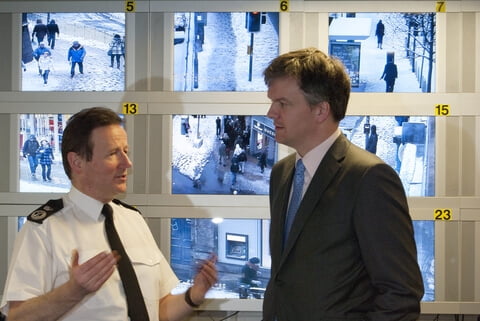
Police Scotland—along with almost every territorial police force in the UK outside London—uses a nine-rank hierarchy running from Constable to Chief Constable. Every new officer joins at the rank of Constable (serving a mandatory two-year probationary period) on a starting salary of £34,001 a year from 1 April 2026. This guide sets out all Police Scotland and UK police officer ranks in order, their parallel detective titles, shoulder epaulette insignia, and the verified 2026 pay scales for each rank.
Police Scotland ranks & pay at a glance (from 1 April 2026)
- Entry rank: Constable (PC) — all new recruits serve a 2-year probationary period in uniformed response policing.
- Rank order (lowest to highest): Constable → Sergeant → Inspector → Chief Inspector → Superintendent → Chief Superintendent → Assistant Chief Constable → Deputy Chief Constable → Chief Constable.
- Detective equivalents: Parallel investigative ranks from Detective Constable (DC) to Detective Chief Superintendent (Det Ch Supt / DCS), carrying the same authority and pay scale as uniformed ranks.
- Starting & constable pay: £34,001 on appointment, £36,995 after 1 year, £39,988 after 2 years, rising to £54,597 at pay point 11.
- Promoted & chief officer pay: From £56,455 (Sergeant pay point 1) up to £281,522 (Chief Constable).
Sources: Police Scotland, pay and grading structure; Police Negotiating Board for Scotland (PNBS) circular 2026-01 (February 2026).
Police Scotland Ranks in Order (Uniformed, Detective & 2026 Salaries)
In Police Scotland, the prefix Police (PC) or standard rank title denotes a uniformed officer, while the prefix Detective denotes an officer who has completed their two-year probation and qualified for investigative duties in departments such as the Criminal Investigation Department (CID).
Detective ranks run parallel to uniformed ranks from Constable up to Chief Superintendent and hold the exact same level of authority and salary. Note the abbreviations at inspecting ranks: the detective equivalent of an Inspector (Insp) is a Detective Inspector (DI), whereas a Detective Chief Inspector (DCI) is the equivalent of a Chief Inspector (Ch Insp / CI). Above Chief Superintendent, chief officers command both uniformed and specialist investigative portfolios without a “Detective” prefix.
| Rank (Lowest to Highest) | Uniformed Abbreviation | Detective Equivalent | Shoulder Epaulette Insignia | Salary (from 1 April 2026) |
|---|---|---|---|---|
| Probationary Constable (Years 1–2) | PC | — (Uniformed response only during 2-year probation) | Plain epaulette with shoulder number | £34,001 on appointment £36,995 after 1 year |
| Constable | PC | Detective Constable (DC) | Plain epaulette with shoulder number | £34,001 to £54,597 (£39,988 after 2 years; top pay point 11 is £54,597) |
| Sergeant | Sgt / PS | Detective Sergeant (DS) | Three point-down chevrons | £56,455 to £61,036 (pay points 1 to 4) |
| Inspector | Insp | Detective Inspector (DI) | Two Bath stars (pips) | £67,491 to £74,853 (pay points 1 to 5) |
| Chief Inspector | Ch Insp / CI | Detective Chief Inspector (DCI) | Three Bath stars (pips) | £76,087 to £80,989 (pay points 1 to 4) |
| Superintendent | Supt | Detective Superintendent (Det Supt / DSupt) | One crown | £89,569 to £105,632 (pay points 1 to 4) |
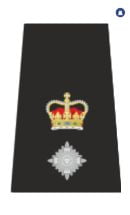
| Chief Superintendent | Ch Supt / CS | Detective Chief Superintendent (Det Ch Supt / DCS) | One crown over one pip | £110,803 to £120,554 (pay points 1 to 4) |
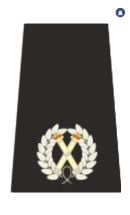
| Assistant Chief Constable | ACC | — (Executive rank) | Crossed tipstaves within a wreath | £164,043 to £174,216 (pay points 1 to 3) |
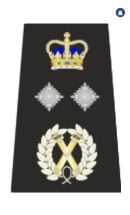
| Deputy Chief Constable | DCC | — (Executive rank) | Crossed tipstaves within a wreath, below one pip | £230,580 |
| Chief Constable | CC | — (Executive rank) | Crossed tipstaves within a wreath, below one crown | £281,522 |
For the complete point-by-point salary tables (including 2025 vs 2026 figures and pension benefits), read our dedicated guide to Police Scotland pay scales and officer salaries.
Understanding Every Police Scotland Rank and Role
1. Probationary Constable & Police Constable (PC / DC)
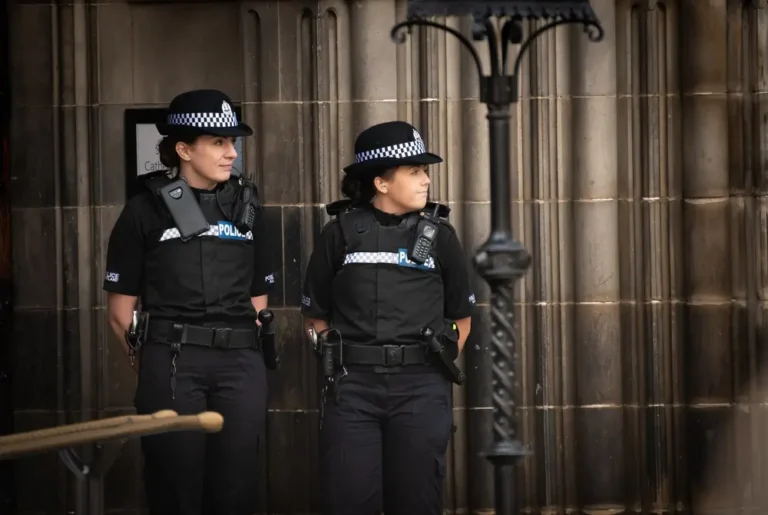
Every police officer in Scotland starts at the rank of Constable. Unlike some forces in England and Wales, Police Scotland has a single entry route: there are no direct-entry Inspector or direct-entry Detective schemes, and no formal academic qualifications or university degree are required to apply (though candidates must be aged 18 or over, have lived continuously in the UK for at least three years, and hold a full manual driving licence).
From the moment you are appointed, you earn the full starting salary of £34,001. All new recruits complete an 18-week initial training programme (which includes 15 weeks of residential or campus training at the Scottish Police College at Tulliallan or the Training and Recruitment Centre in East Kilbride) and serve a mandatory two-year probationary period in uniformed response policing. During this two-year probation, recruits automatically undertake the Modern Apprenticeship in Policing (split across Module 1 initial college training, Module 2 local divisional training, and Module 3 operational tutoring with an evidence portfolio), earning the SQA Certificate in Policing at SCQF Level 7.
Once confirmed in rank at the end of their two-year probation (moving to £39,988 at pay point 2), constables can remain in local response and community policing or apply for specialist roles and training—including CID (Detective Constable), roads policing, public order, cybercrime, dog handling, mounted branch, armed policing, intelligence, wildlife crime, negotiator, or child protection. Constables progress by annual increments to £54,597 at pay point 11.
2. Sergeant (Sgt / DS)
Sergeant is the first supervisory rank in Police Scotland and is reached through competitive promotion selection rather than length of service. Uniformed Police Sergeants (PS / Sgt) lead a shift or team of constables, brief officers at the start of duty, supervise operational incidents on the ground, review crime reports and evidence files for the Procurator Fiscal, or manage police custody suites. Detective Sergeants (DS) supervise teams of Detective Constables within CID and specialist investigation units. From 1 April 2026, Sergeants earn between £56,455 (pay point 1) and £61,036 (pay point 4).
3. Inspector (Insp / DI)
An Inspector is a senior operational manager overseeing multiple teams of sergeants and constables across a response hub, geographical locality, or specialist unit. Uniformed Inspectors often serve as initial critical incident commanders, manage shift resourcing across a subdivision, and lead local community policing partnerships. A Detective Inspector (DI) manages reactive or proactive CID teams investigating serious crime. From 1 April 2026, the Inspector pay scale runs from £67,491 (pay point 1) to £74,853 (pay point 5).
4. Chief Inspector (Ch Insp / DCI)
A Chief Inspector typically serves as an Area Commander within one of Police Scotland’s 13 local policing divisions, overseeing several Inspectors and translating divisional policing priorities into local operational delivery. In investigative commands, a Detective Chief Inspector (DCI) leads major crime enquiries—often acting as the Senior Investigating Officer (SIO) on homicide, serious sexual offence, or complex organised crime investigations. From 1 April 2026, Chief Inspectors earn between £76,087 (pay point 1) and £80,989 (pay point 4).
5. Superintendent (Supt / Det Supt)
Superintendents are senior executive managers within a local policing division or national specialist division (such as Operational Support or the Specialist Crime Division). They oversee major policing operations, Gold/Silver public order or firearms command portfolios, departmental budgets, and multi-agency partnerships with local authorities and emergency services. A Detective Superintendent (Det Supt) heads major investigation teams or national specialist crime portfolios. From 1 April 2026, Superintendents earn from £89,569 (pay point 1) to £105,632 (pay point 4).
6. Chief Superintendent (Ch Supt / Det Ch Supt)
Chief Superintendent is the most senior rank below the Chief Officer (Executive) team. In Police Scotland, a Chief Superintendent typically serves as a Divisional Commander in overall command of one of Scotland’s 13 geographic policing divisions, or as the head of a major national specialist department (where investigative heads may hold the title Detective Chief Superintendent). From 1 April 2026, Chief Superintendents are paid between £110,803 (pay point 1) and £120,554 (pay point 4).
7. Chief Officers: ACC, DCC & Chief Constable
The top three ranks form the Force Executive of Police Scotland—the second-largest police service in the UK, with over 23,000 officers and staff—and are appointed by the Scottish Police Authority (SPA):
- Assistant Chief Constable (ACC) — £164,043 to £174,216 (from 1 April 2026): Each ACC holds executive responsibility for a national portfolio or regional command, such as Local Policing (North, East, or West), Major Crime and Public Protection, Organised Crime and Counter Terrorism, Operational Support, or Professionalism and Assurance.
- Deputy Chief Constable (DCC) — £230,580 (from 1 April 2026): Deputy Chief Constables sit directly beneath the Chief Constable, deputising for them and overseeing the broad pillars of the force (such as Operational Policing, People and Professionalism, and Corporate Services).
- Chief Constable (CC) — £281,522 (from 1 April 2026): The most senior police officer in Scotland, holding overall operational command and statutory responsibility for the direction and delivery of policing across the country.
Special Constables and Police Staff in Scotland
Alongside regular full-time officers, two further groups play a central role in Police Scotland:
- Special Constables: Trained part-time volunteer police officers who commit at least 96 hours a year and hold the exact same warrant and legal powers as regular Police Constables. Note that, unlike forces in England and Wales, Police Scotland does not employ Police Community Support Officers (PCSOs).
- Police Staff: Civilian professionals employed by the Scottish Police Authority/Police Scotland across custody, contact and command centres (999/101), crime scene examination, forensics, intelligence analysis, IT, finance, and human resources.
Police Scotland Ranks and Badges (Shoulder Epaulette Insignia)
Uniformed police officers across Police Scotland and regional UK forces display their rank via insignia on their shoulder epaulettes. Constables and Sergeants also display their unique shoulder number (collar number) on their epaulettes, while officers of Inspector rank and above wear their rank insignia without a collar number.
- Constable (PC): Plain black epaulette showing the officer’s shoulder number (no rank symbol).
- Sergeant (Sgt): Three point-down chevrons (stripes) worn above the shoulder number.
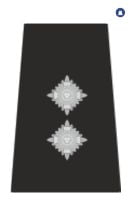
- Inspector (Insp): Two Bath stars (commonly called “pips”).
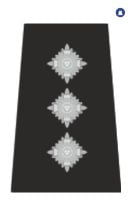
- Chief Inspector (Ch Insp): Three Bath stars (“pips”).
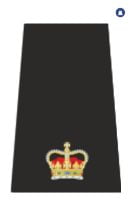
- Superintendent (Supt): One crown.
- Chief Superintendent (Ch Supt): One crown worn above one Bath star (“pip”).
- Assistant Chief Constable (ACC): Two crossed tipstaves surrounded by a laurel wreath.
- Deputy Chief Constable (DCC): One Bath star (“pip”) above two crossed tipstaves within a laurel wreath.
- Chief Constable (CC): One crown above two crossed tipstaves within a laurel wreath.




How Police Scotland Ranks Compare to the Rest of the UK
From Constable to Chief Superintendent, every territorial police force in the United Kingdom—including Police Scotland, the 43 forces in England and Wales, the Police Service of Northern Ireland (PSNI), and the British Transport Police (BTP)—uses the exact same rank titles. Above Chief Superintendent, 41 of the 43 forces in England and Wales also use the same chief officer ranks as Police Scotland (Assistant Chief Constable, Deputy Chief Constable, and Chief Constable).
The only two exceptions in the UK are the Metropolitan Police Service and the City of London Police, which replace the Chief Constable ranks with Commissioner ranks:
| Police Scotland & UK Regional Forces | Metropolitan Police Service | City of London Police |
|---|---|---|
| Constable (PC) | Constable (PC) | Constable (PC) |
| Sergeant (Sgt) | Sergeant (Sgt) | Sergeant (Sgt) |
| Inspector (Insp) | Inspector (Insp) | Inspector (Insp) |
| Chief Inspector (Ch Insp) | Chief Inspector (Ch Insp) | Chief Inspector (Ch Insp) |
| Superintendent (Supt) | Superintendent (Supt) | Superintendent (Supt) |
| Chief Superintendent (Ch Supt) | Chief Superintendent (Ch Supt) | Chief Superintendent (Ch Supt) |
| Assistant Chief Constable (ACC) | Commander | Commander |
| Deputy Chief Constable (DCC) | Deputy Assistant Commissioner (DAC) | Assistant Commissioner |
| Chief Constable (CC) | Assistant Commissioner (AC) | Commissioner |
| — | Deputy Commissioner | — |
| — | Commissioner | — |
Metropolitan Police & City of London Chief Officer Epaulettes
In the Metropolitan Police and City of London Police, Chief Officers above Chief Superintendent wear crossed tipstaves in a wreath combined with pips, crowns, and crest badges corresponding to Commander and Commissioner ranks:


Key Differences Between Joining in Scotland vs England & Wales
While the rank titles look identical, career progression and entry routes in Police Scotland differ in three important ways from forces in England and Wales:
- Single entry route (no degree or PEQF route): Forces in England and Wales recruit under the Policing Education Qualifications Framework (PEQF), such as the Police Constable Degree Apprenticeship (PCDA). Police Scotland has a single police officer entry route requiring no formal academic qualifications; every probationer automatically completes the SCQF Level 7 Modern Apprenticeship in Policing during their two-year probation.
- No Direct Entry Detective route: Every Police Scotland officer must serve their two-year probation in uniformed response policing before applying for CID. Serving officers in England and Wales who joined via a Direct Entry Detective Pathway are not eligible to transfer to Police Scotland as transferees.
- Transferring from another UK force: Serving officers from a recognised Home Office force in England or Wales, the PSNI, or the British Transport Police can apply to transfer to Police Scotland once they have at least three years’ service and no outstanding complaints. Transferees complete a 3-week conversion course at the Scottish Police College, do not repeat probation, and are placed on the Police Scotland pay point matching their length of service.
Every Police Scotland career starts with the 49-question Police Scotland Entrance Test (PSET).
Police Scotland & UK Police Ranks FAQs
What are the Police Scotland ranks in order from lowest to highest?
From lowest to highest, the nine ranks of Police Scotland are: Constable (starting with a two-year period as a Probationary Constable), Sergeant, Inspector, Chief Inspector, Superintendent, Chief Superintendent, Assistant Chief Constable (ACC), Deputy Chief Constable (DCC), and Chief Constable (CC).
What is the difference between a DI and a DCI in Police Scotland?
A Detective Inspector (DI) is the investigative equivalent of a uniformed Inspector (earning £67,491 to £74,853 from 1 April 2026), whereas a Detective Chief Inspector (DCI) is one rank higher and equivalent to a uniformed Chief Inspector (earning £76,087 to £80,989 from 1 April 2026).
How much does each rank earn in Police Scotland in 2026?
From 1 April 2026, Police Scotland salaries by rank are: Constable £34,001 to £54,597 (£36,995 after 1 year, £39,988 after 2 years); Sergeant £56,455 to £61,036; Inspector £67,491 to £74,853; Chief Inspector £76,087 to £80,989; Superintendent £89,569 to £105,632; Chief Superintendent £110,803 to £120,554; Assistant Chief Constable £164,043 to £174,216; Deputy Chief Constable £230,580; and Chief Constable £281,522.
What rank do you start at when you join Police Scotland?
Every new officer joins Police Scotland as a Constable on £34,001 a year from 1 April 2026. You complete an 18-week initial training programme (including 15 weeks at Tulliallan or East Kilbride) and serve a mandatory two-year probationary period in response policing before you can apply for specialist departments or promotion.
Are police ranks in Scotland the same as in the rest of the UK?
Yes. Police Scotland uses the exact same Constable to Chief Constable rank hierarchy as the Police Service of Northern Ireland (PSNI), British Transport Police, and 41 of the 43 forces in England and Wales. Only the Metropolitan Police and the City of London Police use Commissioner and Commander titles for their senior chief officers.
How do you identify Police Scotland ranks by their shoulder badges?
Uniformed rank insignia on shoulder epaulettes are: Constable (shoulder number only), Sergeant (three point-down chevrons), Inspector (two pips), Chief Inspector (three pips), Superintendent (one crown), Chief Superintendent (one crown over one pip), Assistant Chief Constable (crossed tipstaves in a wreath), Deputy Chief Constable (one pip over crossed tipstaves in a wreath), and Chief Constable (one crown over crossed tipstaves in a wreath).
Sources: Police Scotland, pay and grading structure; Police Negotiating Board for Scotland, circular 2026-01 (February 2026); Police Scotland, apply to become a police officer; Police Scotland, police officer transferees. Last checked 13 October 2026.
Realistic mock exams in Language, Numeracy and Information Handling with complete explanations.
Police Scotland Intake Dates 2026: Months, Numbers and Timing
Apply for Police Scotland: Eligibility, PSET and Process