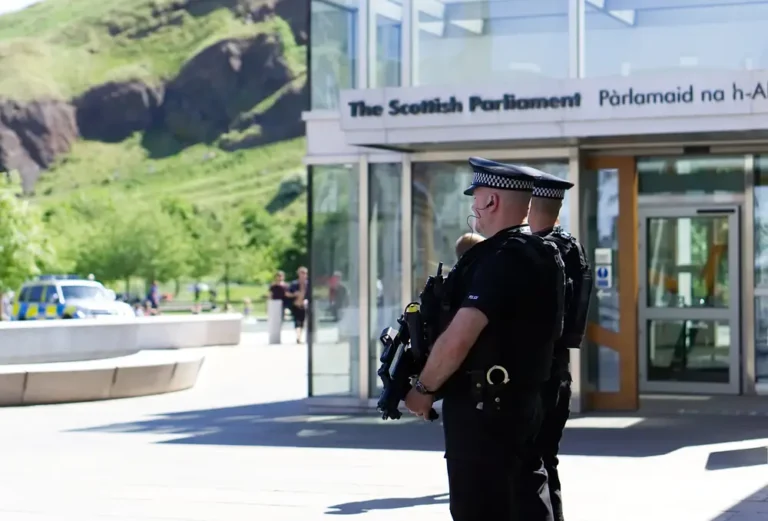

If you are a serving officer thinking about an inter-force transfer to Scotland, the process is shorter than a new-candidate application but it is not a formality. Police Scotland runs a dedicated transferee route with its own eligibility rules, its own vetting decisions and its own training and pay terms.
This guide walks you through each stage in the order you will meet it, using what Police Scotland publishes on its transferee page, so you know what to prepare and what to confirm before you commit.

Who can apply as a Police Scotland transferee
The transferee route is open to serving officers from a recognised Home Office force in England or Wales, the Police Service of Northern Ireland (PSNI) or the British Transport Police. If you serve in one of those organisations, you are in scope for the inter-force transfer process.
Officers from the Ministry of Defence Police, the Civil Nuclear Constabulary and Port of Dover are treated differently. Police Scotland classes them as new candidates rather than transferees, which means foundation training and a period of probation if they are appointed. The three-week course and no-probation terms described later in this article do not apply to them.
One exclusion catches people out. Police Scotland states that officers who joined their home force through a direct-entry detective pathway are not eligible for this transfer route at all.
Service, conduct, residence and licence
Four conditions sit on top of the originating-force test, and all of them appear in Police Scotland’s published eligibility guidance:
- at least three years’ service
- no outstanding complaints
- continuous residence in the UK for the three years before you apply
- a manual driving licence
Check the residence condition carefully if you have spent time posted or living abroad, because it is measured as a continuous three-year period immediately before the application.
Vacancies, the talent bank and timing
Transferee recruitment is not always live. Police Scotland’s transferee page has recently carried no vacancies while keeping an open talent bank for potential transferees, so your first step is to check the careers page for an active transferee window rather than assuming one exists.
Use any quiet period well. Have an informal conversation with your line manager and your Federation rep, and start pulling together your PDR history and any live-issues declaration, because both sit at the heart of a transferee application. A clean, complete PDR history is far easier to assemble while you are still in post than in the middle of a short application window.
Building the application around the CVF
The application form is based on the CVF (Competency and Values Framework). You are expected to evidence the values and the competencies you have built across your policing career, which means concrete examples rather than a summary of your postings.
Police Scotland is explicit that applications are sifted to the same high standards expected of any applicant to the organisation. Experience does not soften the sift. If your written evidence is thin, the application stops there, whatever your service length.
References, vetting and the Statutory Vetting Code
If you clear the sift, Police Scotland carries out background checks. These include reference checks with your current force, followed by checks involving your local Professional Standards Department and Vetting.
Transfer vetting works differently from recruit vetting in one important respect: intelligence held by your current force follows you. It is passed to Police Scotland’s vetting decision-maker and assessed under the Statutory Vetting Code. You should assume that anything recorded about you locally will be visible to the decision-maker, including matters that were never taken to a formal outcome.
Live misconduct or performance proceedings normally pause a transfer until they are concluded. That is why the “no outstanding complaints” eligibility line matters so much, and why the background checks stage is where most transfer timelines stretch.
How long does transferee vetting take?
Police Scotland does not publish a separate vetting-only timescale on its transferee page. What it does publish is the sequence: references with your current force, then Professional Standards and Vetting, then the final health stage. Because the Statutory Vetting Code assessment depends on what your force holds and how quickly it responds, the honest answer is that the duration varies by case. Ask the recruitment team for a current expectation when a window opens, and keep your own paperwork ready so you are never the bottleneck.
The competency based interview

Successful applicants are invited to a competency based interview built on the same Competency and Values Framework as the form. It is your opportunity to evidence the values, skills and experience you hold as a serving officer.
The values Police Scotland lists for this stage are:
- we analyse critically
- we are collaborative
- we deliver support and inspire
- we are emotionally aware
- we take ownership
- we are innovative and open minded
Further guidance on the interview is released through the application centre once you register, so register early and read it before you start writing examples. Prepare one strong, recent policing example per value, with your own actions clearly separated from the team’s.
Promotion assessments for specialist opportunities and senior ranks
Police Scotland accepts transferees from all substantive ranks. Suitability is judged against organisational requirements, your desired transfer area, and your experience, skills and specialisms, so a constable and an inspector are assessed against different needs.
Promotion assessments are not a universal stage. For transfers into specialist roles and senior ranks you will typically undertake the Police Scotland national promotion assessments, with further details shared if you succeed at the initial application stage. If you are moving at your current rank into a general policing role, this stage will not usually apply.
Specialist opportunities are a common reason officers look north, whether that is Major Investigation Teams, Armed Policing or other national capabilities. Treat any specialist posting as a separate selection conversation rather than something that follows automatically from a transfer, and raise your target area early so expectations are set before vetting completes.
Fitness assessment: the shuttle run to level 5.4

The fitness assessment is a shuttle run on a 15-metre track, timed against a series of audio beeps. You must beat the bleep and complete each shuttle before the sound, and the gap between beeps shortens at the end of every level, so the pace rises as you go.
The required police officer standard is level 5.4, which Police Scotland describes as completing at least four shuttles at level 5. The purpose is to confirm you are fit for the job and ready for Officer Safety Training, where you learn to protect yourself and others.
Do not treat this as the easy stage because you are already operational. Police Scotland states that more people fail the fitness test than any other stage of the recruiting process, and advises applicants to begin preparing immediately and to arrive at the peak of their physical fitness.
Health appointment and substance misuse test
The health appointment with Police Scotland’s Health Provider confirms that you are fit and healthy and meet the standards required of an operational police officer. It includes an eyesight test and a BMI check.
Candidates are also subject to a Substance Misuse Test at this stage. Once every stage of the process is complete, you receive an offer of employment, and that is the point at which Police Scotland works with you to finalise your transfer date.
Three weeks of training, and no probation
Eligible officers transferring from a force outside Scotland complete a three-week course, delivered at the Scottish Police College and locally. There is no further period of probation for eligible transferees, which is the clearest practical difference between this route and a new-candidate application.
The course is where Scottish law and Police Scotland procedure are bedded in, so expect the content to differ from your current force’s refresher training rather than repeat it. Remember that officers routed as new candidates, including those from the non-Home Office forces listed earlier, face foundation training and probation instead.
Pay, allowances and pension on transfer
Pay is matched to the equivalent Police Scotland rate based on your length of service, so your pay point is derived from service rather than carried across unchanged. Existing housing allowances received before August 1994 continue.
Base pay and allowances are worth modelling before you accept. Police pay and conditions in Scotland are negotiated through the Police Negotiating Board for Scotland (PNBS) on a separate Scottish scale, so a like-for-like comparison with your current force needs the full package, your target area’s cost-of-living index and your commuting costs, not just the headline figure.
What transferring means for your pension
A transfer also means a change of pension arrangements. Scottish officers contribute to the Scottish Police 2015 Scheme, administered by the Scottish Public Pensions Agency (SPPA), and the SPPA publishes its current terms:
- member contribution rate of 13.7% of pensionable pay from April 2025, with an employer contribution of 38.7% for 2024 to 2027
- career average accrual of 1/56.1 of pensionable pay for each year of pensionable service
- a normal pension age of 60 for members paying into the scheme when they retire, with early retirement available from 55 subject to actuarial reduction
- the option to exchange pension for a tax-free lump sum at £12 of lump sum for every £1 of annual pension given up, up to a maximum of 35.7% of the pension fund
- Additional Pension purchase up to a maximum of £6,500
- death-in-service cover of 3 times pensionable pay
The SPPA is also working through the public service pensions remedy, with a delivery target of issuing Remediable Service Statements by the end of March 2027.
What the transferee page does not set out is how your existing pension service is treated on transfer, or how the equivalent pay rate is calculated line by line. Raise both with the recruitment team and with the SPPA before you accept an offer, because a pension decision taken at the point of transfer is hard to unwind later.
Comparing Police Scotland with your current service
Scale and workload differ sharply between services, which is worth weighing alongside pay. The comparison below sets Police Scotland against the PSNI, one of the recognised originating services for this route, with crime rate figures drawn from Office for National Statistics data for the year to December 2025.
| Dimension | Police Scotland | Police Service of Northern Ireland |
|---|---|---|
| Region | Scotland | Northern Ireland |
| Officers | 16,800 | 7,100 |
| Pay supplement | Separate Scottish scale | NITA £4,283 |
| Cost-of-living index | mixed | mixed |
| Crime rate / 1,000 (ONS, yr to Dec 2025) | 54.8 | 46.3 |
| Transfer intake ease | difficult | difficult |
Two points stand out for anyone planning a move. Intake is tight, so a live window matters more than ambition, and the Scottish scale means your package has to be checked rather than assumed.
Shift patterns and weekly hours are not published on the transferee page, so if rostering is central to your decision, ask the recruitment team directly rather than relying on your current force’s arrangements as a guide.
Frequently Asked Questions
Who is eligible to transfer to Police Scotland?
The transferee route is for serving officers from a recognised Home Office force in England or Wales, the PSNI or the British Transport Police, with at least three years’ service and no outstanding complaints. You must also meet the continuous three-year UK residence condition and hold a manual driving licence.
Can officers from the MOD Police, Civil Nuclear Constabulary or Port of Dover use the transferee route?
No. Those officers are treated as new candidates. If appointed, they follow the new-candidate foundation training and probation route rather than the three-week course and no-probation terms available to eligible transferees.
Can a direct-entry detective transfer to Police Scotland?
No. Police Scotland states that officers who joined their home force through a direct-entry detective pathway are not eligible for this transfer route.
What does Police Scotland assess in a transferee application?
The application is built on the Competency and Values Framework, with evidence of values and competencies drawn from your policing career. The wider assessment then adds references and vetting or background checks.
What happens at the competency-based interview?
It is a competency based interview using the Competency and Values Framework, and it is your chance to evidence your values, skills and experience as a serving officer: critical analysis, collaboration, support and inspiration, emotional awareness, ownership, and being innovative and open minded.
Do all transferees have to complete promotion assessments?
No. Police Scotland says the national promotion assessments typically apply to transfers into specialist roles and senior ranks, with further details shared if you pass the initial application stage.
What fitness standard applies to a Police Scotland transferee?
The fitness assessment is a shuttle run on a 15-metre track timed by audio beeps, and the required police officer standard is level 5.4, described by Police Scotland as completing at least four shuttles at level 5.
What health checks are part of the transfer process?
At the health appointment, a Health Provider confirms you are fit and healthy and meet operational standards. The stage covers an eyesight test and a BMI check, plus a Substance Misuse Test.
Is there probation after transferring to Police Scotland?
No probation applies to eligible officers transferring from outside Scotland. You complete a three-week course at the Scottish Police College and locally, and once all stages are finished your pay is matched to the equivalent Police Scotland rate based on length of service.
How long does Police Scotland transferee vetting take?
Police Scotland does not publish a separate vetting-only timescale on its transferee page. The published checks cover references with your current force, your local Professional Standards Department and Vetting, with current-force intelligence considered under the Statutory Vetting Code. Live misconduct or performance proceedings typically pause the transfer.
Your next step
If a transferee window is not open, build the file you will need: PDR history, live-issues declaration, CVF examples against the six values, and a fitness plan aimed squarely at level 5.4. Those four items are what separate a quick transfer from a stalled one.
If you are also weighing the new-candidate route, or supporting someone who is, start with a realistic practice run of the entrance test at https://www.jointhecops.co.uk/free-pset/ and then confirm your own route and terms directly with Police Scotland.
Sources
Realistic mock exams in Language, Numeracy and Information Handling with complete explanations.
Police Scotland Training: 18 Weeks, Probation and Modules

Police Scotland Special Constable to Regular Officer: Full Guide