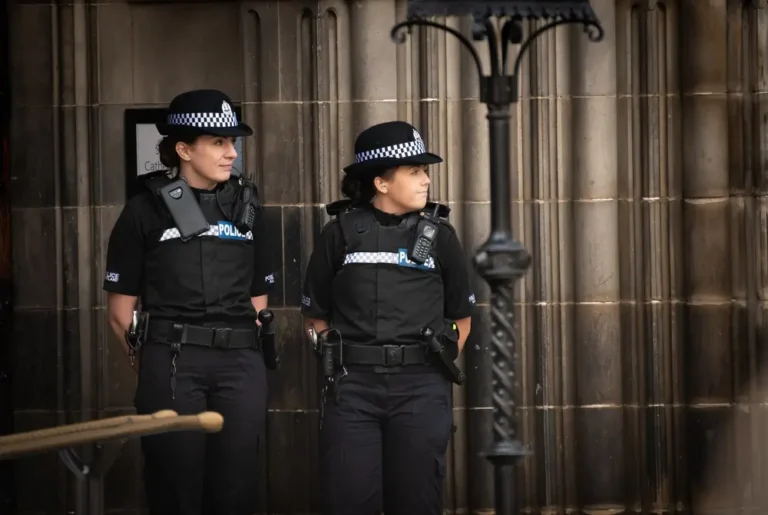
If you’re applying to Police Scotland, you need a clear picture of what training actually involves before you commit. The pathway is longer than most people expect, it starts well before you reach a classroom, and it ends with a two-year probation in response policing rather than a graduation certificate alone.
This guide walks you through the full route: eligibility, the recruitment stages including the PSET (Police Scotland Entrance Test), what happens across the 18-week initial course, and how the modules build towards the Certificate in Policing. Every figure here comes from Police Scotland, the Scottish Police Authority (SPA), Skills Development Scotland or Scottish legislation.
Police Scotland training timeline: 18 weeks, then two-year probation
For intakes starting on 12 January 2026, Police Scotland’s initial training lasts 18 weeks. Of that, 15 weeks are spent at the Scottish Police College at Tulliallan or at the Training and Recruitment Centre in East Kilbride. The programme also includes one week at a regional training centre early on and a further two weeks at a regional centre at the end.
That 18-week model extends the previous 16-week programme. Police Scotland’s December 2025 news release confirms the change, with extra emphasis on applying legislation, fitness, wellbeing, investigation and victim support. If you read older material quoting 12, 14 or 16 weeks, it predates this intake.
Training does not stop when the college phase ends. After the initial 18 weeks, you serve a two-year probation in response policing, supported by a tutor constable and building practical evidence as you go. Probationer training is modular and delivered across the two years, split between the training establishment and your division.
The whole pathway sits inside the Police Scotland Modern Apprenticeship in Policing. Skills Development Scotland’s framework sets it at roughly two years, combining college-based learning, local divisional training and an operational phase on the street.
Residential or non-residential?
Tulliallan is Police Scotland’s headquarters as well as the home of the Scottish Police College, so it’s natural to assume every recruit lives in. That isn’t guaranteed. The SPA’s June 2024 paper on the revised approach to initial training describes a flexible delivery model in which residential courses run concurrently with non-residential ones, so officers can begin and complete probationer training locally where possible.
Police Scotland trialled that approach with the cohort that passed out in October 2024, specifically to help people with caring responsibilities return home each day. Staying local also helps you get familiar with your policing area and build relationships with the officers you’ll work alongside.
Eligibility before Police Scotland training
You must be 18 or over to be appointed as a police officer, although Police Scotland accepts applications from 17 and a half. There’s no upper age limit set in the Modern Apprenticeship framework, so joining in your forties is possible provided you meet every other requirement.
Residency matters. You need to have lived continuously in the UK for at least three years immediately before applying, and you must satisfy right-to-work rules. Non-UK or EEA nationals need indefinite leave to remain or equivalent status at the point of application.
On the practical side, you must hold a manual driving licence when you apply, be physically and mentally able to carry out police duties, and meet the national eyesight standard. Police Scotland is explicit that no formal academic qualification is required. A degree isn’t an entry requirement, and relevant life experience counts for a great deal. You also need to be willing to work in any local division in Scotland once probationary training is complete.
Two financial and driving thresholds cause automatic rejection under Police Scotland’s published criteria: defaulted accounts totalling £1,000 or more, and more than 6 points on your driving licence. Check both before you start the form.
The Police Scotland recruitment route
The process starts online. You create an account on the job portal and complete the application form, then manage your progress from that account. Police Scotland contacts you at each step, and how fast you move through is largely up to you. Fail the pre-screening and you can reapply once you meet the criteria.
The Scotland-specific route then covers the application, the PSET, a fitness assessment, an assessment day, medical checks and vetting before any offer of employment. The published eligibility material groups these into five broad stages, each designed to test aptitude, character and physical suitability.
You’ll be asked to declare any criminal convictions and any tattoos. Each case is considered on its own merits, with checks made by the vetting unit at the pre-appointment stage. The Force Vetting Unit may occasionally make an early assessment of vetting suitability, decided case by case.
Accuracy is not optional. Everything you supply during the application is confirmed at the vetting stage, so an error or omission early on becomes a problem later.
PSET preparation: the Scottish test to plan for
The PSET assesses three things: understanding of language, information handling and numeracy skills. It consists of 49 questions completed in 60 minutes, which means pace is as much of a challenge as knowledge.
Police Scotland publishes example PSET questions and answers, and states clearly that it does not endorse any study materials. That makes your choice of preparation your own responsibility. The key point is to use Scotland-specific practice: the PSET is not the same test used by forces elsewhere in the UK, and generic UK-wide materials can mislead you on format and timing.
Work on all three papers rather than only the one you find comfortable. Numeracy under time pressure and information handling from dense text are where most candidates lose marks, and both improve quickly with timed practice.
Fitness requirements before and during probation

The recruitment fitness assessment is a multi-stage fitness test, commonly called the bleep test. You run up and down a 15-metre track, timed against a series of audio beeps, and you must complete each length before the beep sounds. The minimum passing standard at recruitment is level 5.4.
Police Scotland frames this as more than a one-off run. The assessment is there to establish whether you’re fit for the job and ready for Operational Safety Training, where you learn to protect yourself and others.
Timing matters too. The fitness assessment must be completed within six months of receiving a start date. If that window expires, you’ll need another fitness test before a formal offer can be issued.
The bleep test then follows you into training. Police Scotland’s October 2025 freedom of information disclosure on training courses confirms 2 fitness tests during Module 1, with a further 3 fitness tests scheduled later in the programme. Arriving at Tulliallan barely scraping level 5.4 is not a comfortable position.
Assessment day, interview and vetting
The assessment centre stage is built around exercises designed to test your potential as a constable. All of them are assessed against the Police Scotland Competencies and Values Framework, and the competencies and values are considered throughout the day.
The Group Task runs for 50 minutes in total: 10 minutes of independent reading and comprehension of a short policing-related scenario of roughly 500 to 600 words, a 30-minute group discussion and briefing to assessors, then a 10-minute assessor question and answer session.
The Situational Judgement Exercise lasts 60 minutes. Assessors verbally present an unfolding hypothetical policing scenario to your group, and each candidate is asked individually about their considerations and intended course of action. There’s also a 20-minute competency-based interview with four questions mapped to the Competencies and Values Framework.
Vetting checks are carried out once you have successfully completed the application process. As above, everything you declared gets confirmed here, so consistency between your form and your vetting paperwork is essential.
Module 1: college learning and final assessments

The Skills Development Scotland Modern Apprenticeship framework, published in October 2018, describes the initial training phase as a 12-week Module 1 at the Scottish Police College. Police Scotland’s March 2024 news release on the oath of office ceremony also referred to a 12-week initial module. That historic framework figure sits alongside, not inside, the current 18-week model for intakes from 12 January 2026. Read the 12 weeks as the framework’s description of Module 1, and the 18 weeks as what you’ll actually experience if you start in January 2026.
Module 1 is delivered at the college, meaning the Scottish Police College or the Training and Recruitment Centre. The framework lists subject areas including Scots Criminal Law, health and wellbeing, general police duties, search training and roads policing.
It concludes with a multiple-choice Final Course Examination. If you don’t pass first time, Police Scotland’s freedom of information disclosure confirms you can resit it up to a maximum of 2 resits. Alongside the written exam, Module 1 includes assessments in emergency life support, Operational Safety Training and search techniques, plus the two fitness tests.
Modules 2 and 3: local training and operational probation
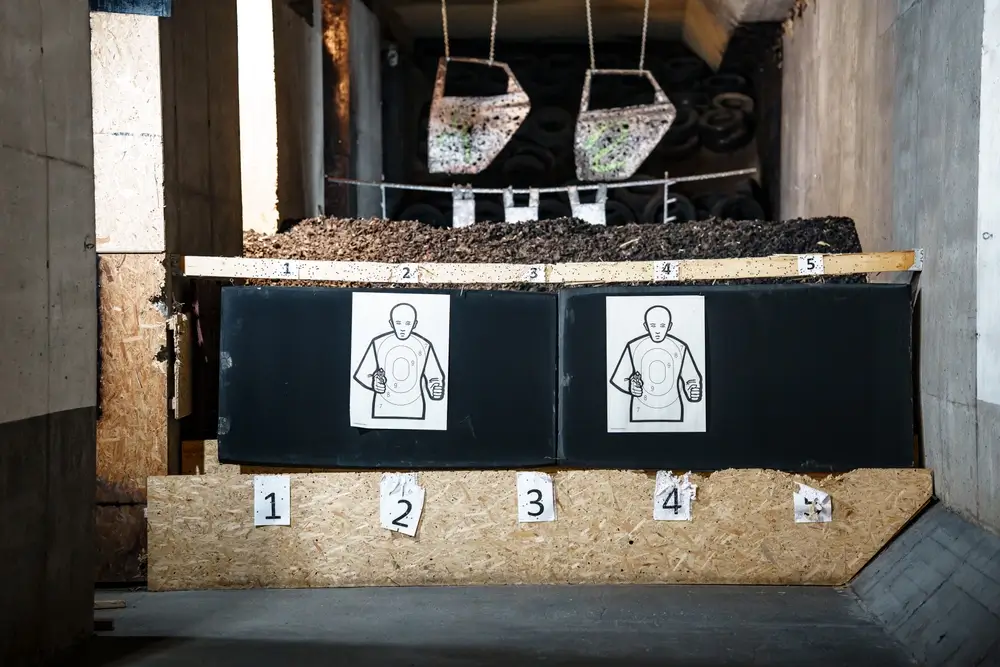
Module 2 shifts the focus to local divisional training. You learn the systems and procedures of the division where you’ll actually be working. The framework description doesn’t attach a formal assessment to this module.
Module 3 is the operational phase. You work under a tutor constable and compile an evidence portfolio drawn from real operational experience. This is where classroom law becomes decisions made at the roadside and on doorsteps.
The two-year probation is served in response policing roles, with tutor support and evidence-building continuing throughout. Police Scotland describes policing as a 24/7 public service with varied shift patterns. In practice, the published job profile for the role sets out a 40-hour shift pattern covering evenings, nights, weekends and public holidays, with longer days and flexibility sometimes required. You’ll work outdoors in all weathers, in patrol cars, and indoors at stations, courts, homes, schools and community centres.
The scale of the job is worth understanding before you start. Police Scotland covers 28,168 square miles according to its official MyJobScotland profile, and receives over three million contacts annually, including over four thousand 101 non-emergency calls daily and two thousand 999 emergency calls daily, handled through three Area Control Rooms.
Certificate in Policing and passing out
Complete the programme and you earn the SQA Certificate in Policing at SCQF level 7. Police Scotland’s freedom of information disclosure states that the qualification carries 170 credits, and Qualifications Scotland’s qualification structure sets out 9 mandatory units.
This is a competence-based qualification developed for Police Scotland and available only through the Scottish Police College at Tulliallan, based on National Occupational Standards defined by Skills for Justice. Entry is at the discretion of the college and subject to the probationer selection process. Assessment runs through a series of theoretical and practical tasks, with open-book or closed-book conditions depending on the task.
The Modern Apprenticeship also requires core skills: Communication, Working With Others, Problem Solving and Information and Communication Technology at SCQF level 6, plus Numeracy at SCQF level 4. All except Numeracy are embedded within the mandatory qualification; Numeracy is separately certificated.
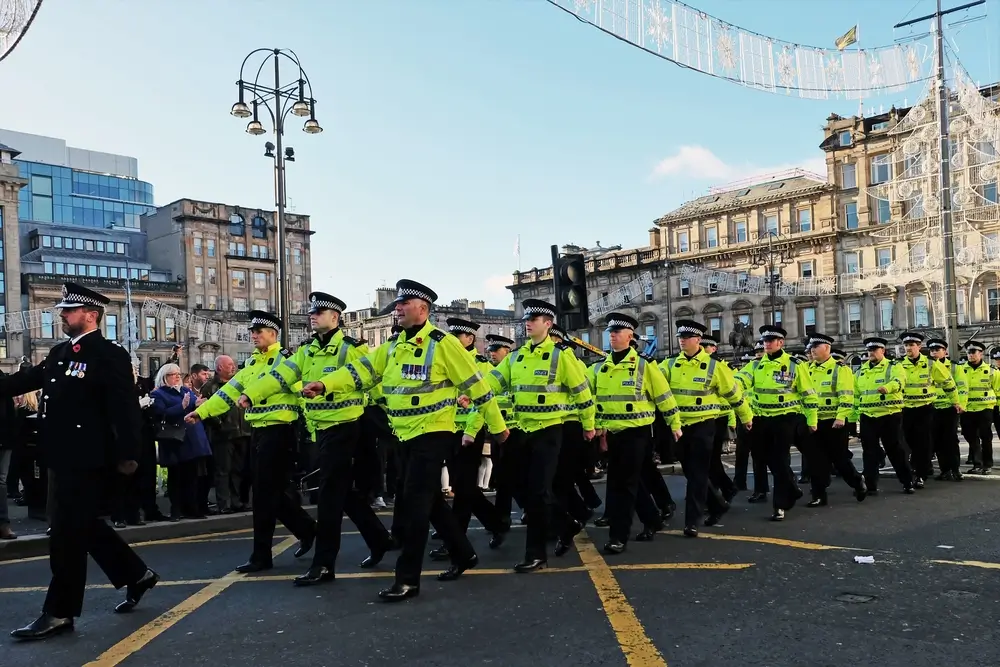
Passing out parades are held at Tulliallan to mark the end of the college-based phase. When 250 new officers passed out there on 18 October 2024, Chief Constable Jo Farrell put it simply:
“Policing is a hugely rewarding and demanding vocation, and I congratulate our latest cohort of officers for successfully completing their training.”
Pay and the oath of office
You’re paid from day one. Police Scotland and SPA material confirms that recruits are paid as constables from the date of appointment, including during initial training and probation. Police Scotland’s recruitment page lists a starting salary of £34,001.00, rising through annual increments to £54,597.00 over 11 years. A Police Scotland constable vacancy published on MyJobScotland on 25 September 2026 advertised a pay range of £31,466.00 to £50,528.00, so check the live advert for the band attached to your intake.
Appointment as a constable only takes legal effect once you have made the declaration before a sheriff, summary sheriff or justice of the peace. The Oath of Office is set out in the Police and Fire Reform (Scotland) Act 2012 and now reads:
“I, do solemnly, sincerely and truly declare and affirm that I will faithfully discharge the duties of the office of constable with fairness, candour, integrity, diligence and impartiality, that I will follow the Code of Ethics for Policing in Scotland and that I will uphold fundamental human rights and accord equal respect to all people, according to law.”
The Duty of Candour wording was added to that declaration, and Police Scotland’s July 2025 release described new recruits swearing it to strengthen standards of professional behaviour. The Code of Ethics for Policing in Scotland is therefore not optional reading: it’s part of what you formally commit to.
How competitive is it?
Police Scotland runs several intakes a year. Its published 2025 intake table shows cohort sizes including 124 probationers in the first intake of the year and 137 in the fifth, so places are finite and filled by the strongest applicants in each round.
The process is demanding because it tests several different things: aptitude in the PSET, character and judgement at the assessment day, physical readiness at the fitness test, and integrity at vetting. None of those stages is designed to be scraped through. The upside is that no formal academic qualifications are required, which means preparation, not prior schooling, is what separates candidates.
Frequently Asked Questions
How long does Police Scotland training take?
For intakes starting on 12 January 2026, initial training lasts 18 weeks, including 15 weeks at Tulliallan or the Training and Recruitment Centre in East Kilbride. It’s followed by a two-year probation in response policing.
Is Police Scotland training paid, and how much do recruits earn?
Yes. Police Scotland and SPA material confirms recruits are paid as constables from the date of appointment, including during training. Police Scotland’s recruitment page lists a starting salary of £34,001.00, rising to £54,597.00 over 11 years of annual increments. Check the current advert for your intake before you apply.
What is the Police Scotland recruitment process?
An online application, the PSET, a fitness assessment, assessment day exercises, medical checks and vetting, followed by an offer. The PSET is 49 questions in 60 minutes covering language, information handling and numeracy.
Is it hard to get into Police Scotland?
It’s demanding because it tests aptitude, character, physical suitability, communication, judgement and vetting across several stages. Police Scotland requires no formal academic qualifications, but you need to prepare properly for each stage and meet every eligibility requirement.
What are the eligibility requirements for Police Scotland?
You must be at least 18 to be appointed, have lived continuously in the UK for at least three years immediately before applying, meet right-to-work and eyesight requirements, and be physically and mentally able to perform police duties. A manual driving licence is required. No formal academic qualification is needed.
Can you join Police Scotland at 40?
Yes. The Modern Apprenticeship framework sets no upper age limit. You still need to meet the current requirements on residence, right to work, manual driving licence, fitness, eyesight, vetting and selection.
Do you need a degree or GCSEs to join Police Scotland?
No. Police Scotland states that no formal qualifications are required and that relevant life experience and skills matter most. A degree is not an entry requirement. Check the current Police Scotland page before you apply.
Where is Police Scotland headquarters, and do you stay at Tulliallan?
Police Scotland’s headquarters and the Scottish Police College are both at Tulliallan. For intakes from 12 January 2026, 15 of the 18 initial-training weeks are at Tulliallan or East Kilbride, but the delivery model includes both residential and non-residential courses, so don’t assume every recruit lives in.
What oath do Police Scotland recruits take?
Appointment as a constable takes effect only once the declaration is made. The current Scottish declaration covers fairness, candour, integrity, diligence and impartiality, following the Code of Ethics for Policing in Scotland, and upholding fundamental human rights and equal respect for all people according to law.
What’s probation and shift work like in Police Scotland?
After the 18-week initial phase, probation lasts two years in response policing, with tutor constable support and an evidence portfolio. Policing is a 24/7 public service, so expect evenings, nights, weekends and public holidays alongside demanding operational work.
Your next step
Training is the part you can’t control yet. The PSET is the part you can. It’s the first real filter in the process, it’s Scotland-specific, and it rewards timed practice more than anything else.
Start there: take a free PSET practice paper at https://www.jointhecops.co.uk/free-pset/ and find out where you stand on language, information handling and numeracy under the 60-minute clock. This platform is independent and is not official or affiliated with Police Scotland. Always confirm current requirements on the official Police Scotland recruitment pages before you apply.
Sources
- Police Officer Attrition and Recruitment – spa.police.uk
- Police Scotland College – scotland.police.uk
- Modern apprenticeship – skillsdevelopmentscotland.co.uk
- Policing – apprenticeships.scot
- Police and Fire Reform (Scotland) Act 2012 (asp 8) – legislation.gov.uk
- Police Scotland: Course Content – moodle.scotland.police.uk
Realistic mock exams in Language, Numeracy and Information Handling with complete explanations.
Police Scotland Special Constable to Regular Officer: Full Guide
Police Scotland Intake Dates 2026: Months, Numbers and Timing