
The quiz at the top of this page is multiple choice to keep it quick. In the numeracy section of the official PSET mock, you write your own answers in figures.
The Police Scotland maths test is not a stand-alone exam. It is the numeracy element of the Police Scotland Entrance Test (PSET), alongside language and information handling. If you are searching for the maths part specifically, this guide gives you the question families, the methods behind them and a realistic way to practise.
One point matters before you start. The official mock material presents short written calculations, and you enter your answers in figures with the unit the question asks for. That means your method has to produce a clean, labelled number, not a rough estimate you hope is close enough.
This guide stays on the maths. It does not restate the whole recruitment timeline, and it does not invent rules Police Scotland has not published. Where the force is silent, you will see that said plainly rather than filled in with guesswork.
What the Police Scotland PSET numeracy element actually covers
The Police Scotland Entrance Test contains three core elements: numeracy, literacy and information handling. The official mock paper covers all three, and Police Scotland’s recruitment process page does not say how the questions are divided between them. You should prepare as if every element could carry real weight.
The maths itself is school-level and applied. Think percentages, ratios, unit conversions, speed, distance and time, weekly totals and mental arithmetic. None of it is advanced. What makes it hard is the switching between question types and the need to present a precise answer with the right unit.
A final framing point. Police Scotland’s own recruitment pages and the instructions it sends you are the live rules. Anything you read elsewhere, including this guide, is practice guidance that helps you build method and speed. If the two ever disagree, the force’s current instructions win.
The numeracy question families to drill
The official mock questions show the kinds of calculation to expect. They fall into five families.
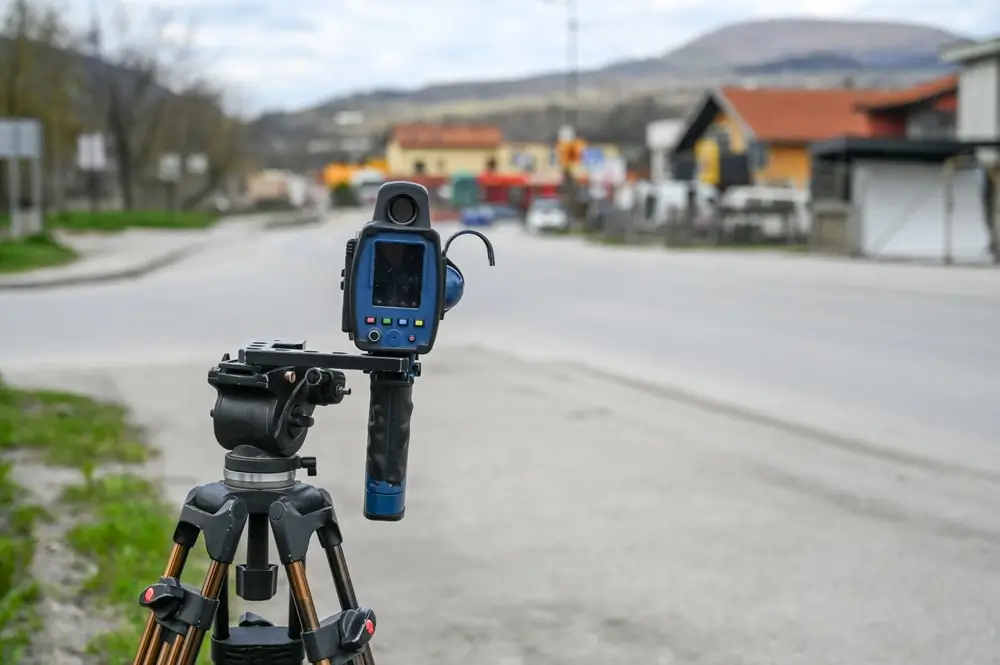
Speed over a limit. You are given a recorded speed and a permitted limit, and you work out how far above the limit the vehicle was travelling. Simple subtraction, but you must read which figure is the limit and which is the recorded speed.
Officer-to-crowd ratios. You are given a crowd size and a required ratio of officers to crowd, such as 1:2,000, and you work out how many officers are needed. Keep the ratio in the order it is written.
Combined weights. Several items are weighed and you add them. Watch for a weight given for each item, which you multiply first, and for mixed units, which you convert first.
Weekly totals. Repeated amounts across a period are added into one figure. Organisation beats speed here.
Percentage reductions and distance from speed and time. The mock includes a sentence reduced by a percentage and a distance calculated from a stated speed over a stated time. Both are standard methods you should be able to run without thinking.
The worked examples below use original figures rather than reproducing mock items. The point is the method, which transfers to whatever numbers appear on the day.
Percentage reductions: keep the original amount in view
Start by finding the percentage of the starting amount: that is the reduction. Then read the question again. If it asks how much is taken off, the reduction is your answer. If it asks what is left, subtract the reduction from the starting amount. The official mock asks how much a judge took off a sentence, so the answer there is the reduction itself.
Take a sentence of 24 months reduced by 25 per cent. First, 25 per cent of 24 is 6, so 6 months is taken off. If the question asks what is left, 24 minus 6 gives 18 months. Original amount 24, reduction 6, final amount 18. Three labelled values, one line of working each. If the answer is wanted in years and months, convert at the end: 15 months is 1 year and 3 months.
The checking habit matters more than the calculation. A reduction must leave you with less than you started with. If your answer is larger than the original figure, you have added instead of subtracted, or you have taken the percentage of the wrong number. A quick estimate catches that in seconds: a quarter off 24 should land somewhere near 18, so a result of 30 is obviously wrong.
When the percentage is awkward, break it down. Ten per cent of 24 is 2.4, so 30 per cent is 7.2. Working in tens and fives is usually faster than reaching for long multiplication, and it is less likely to go wrong under pressure.
Ratios: turn parts into the requested quantity
Order is everything in a ratio. If the question states officers to crowd as 1:40, that is one officer for every forty people in the crowd. Reversing it changes the meaning of the whole calculation, and the answer will look plausible while being completely wrong.
When the question gives you the crowd size, divide it by the crowd side of the ratio. A crowd of 6,000 at 1:40 needs 6,000 ÷ 40 = 150 officers. This is the type of ratio question in the official mock.
When the question gives a total that includes both groups, the method changes: add the parts, divide the stated total by that number to find one part, then scale each side.
Say a total of 861 people is made up of officers and crowd in the ratio 1:40. Add the parts: 1 plus 40 is 41. Divide the total: 861 divided by 41 is 21. So one part is 21. The officers are 1 × 21 = 21, and the crowd is 40 × 21 = 840.
Now check. 21 plus 840 equals 861, which matches the stated total. If the parts do not add back to the total, something has gone wrong in the division and you should redo it before moving on.
Finish by keeping the description the question asked for. If it wants the number of officers, give the officer figure, not the crowd figure and not the full split. Answering the wrong half of a correctly solved ratio is one of the easiest marks to throw away.
Unit conversions and combined weights
Mixed units are the main reason combined-weight questions go wrong. Convert everything into the same unit before you add or compare anything.
Suppose you are asked for the combined weight of three recovered items: 1.2 kg, 450 g and 0.35 kg. Convert 450 g into 0.45 kg first. Then add: 1.2 + 0.45 + 0.35 = 2 kg. Doing the conversion at the start, before any addition, keeps the sum honest.
The same discipline applies in reverse. If the question asks for the total in grams, convert at the end: 2 kg becomes 2,000 g. The arithmetic is identical; what changes is the label on the answer.
Check the unit every time. The official mock questions and answer key use mph, kilos, £ and miles, so make sure your figure is in the requested unit. Build this checking habit during practice.
Speed, distance and time
One relationship covers everything in this family: distance = speed × time. Rearrange it when the unknown changes. Speed = distance ÷ time. Time = distance ÷ speed.
The mock asks you both to calculate a distance from a stated speed and time, and to compare a speed with a limit. The second is subtraction; the first needs the formula and consistent units.
A patrol vehicle travels at 48 mph for 45 minutes. Do not multiply 48 by 45. Convert the time first: 45 minutes is 0.75 hours. Then 48 × 0.75 = 36 miles. The unit conversion is where the question is won or lost.
Useful conversions to know by heart: 30 minutes is 0.5 hours, 15 minutes is 0.25 hours and 20 minutes is roughly 0.33 hours. Making the conversion automatic saves time you can spend on the harder items.
State the unit with your answer: miles, mph, minutes or hours, whichever the question requested. A correct number with the wrong unit does not read as a correct answer.
Weekly totals and mental arithmetic
Weekly-total questions reward organisation. Group like quantities, keep the time period visible in your working and add in a structured order rather than jumping around the figures.
If a shift pattern involves 9 hours on four days and 6 hours on two days, handle each group separately. Four lots of 9 is 36. Two lots of 6 is 12. Total 48 hours in the week. Splitting the sum into two clean multiplications is quicker and safer than adding six numbers in a row.
Mental arithmetic across all four operations is worth drilling. Addition, subtraction, multiplication and division all appear, and being fluent means you can pick the simplest route before you write anything down. Breaking numbers into manageable parts is usually that route: 7 × 48 becomes 7 × 50 minus 7 × 2, which is 350 minus 14, or 336.
Build two checks into every answer. Estimate first, so you know roughly where the result should land, and use an inverse operation afterwards where it is quick. If you divided, multiply back. A misplaced digit or a wrong sign shows up immediately.
Timed drills are useful for practising your pace. They do not, however, tell you anything about an official threshold. Treat your practice scores as a measure of your own progress, nothing more.
Answer presentation and self-checking
Short written calculations mean short written answers. Enter the figure, attach the unit the question asked for, and move on.
The habit worth building in practice is showing three things on the page: the operation, the intermediate value and the final answer. That structure is what lets you spot where a wrong answer went wrong, which is the whole point of practising rather than just answering.
Your final check is three questions. Is the result the right size for the question? Does it have the right sign or direction, so a reduction is smaller and an addition is larger? Does it carry the right unit? Those three take a few seconds and catch most avoidable errors.
Keep your practice material in your own numbers and your own scenarios. Memorising specific mock items teaches you nothing transferable: use fresh figures, so you test your method rather than your memory of the mock answers.
What Police Scotland’s recruitment process page does not give
Several things applicants want to know are not on Police Scotland’s recruitment process page or in its mock paper, and it is better to say so than to repeat an assumption.
The page gives no PSET numeracy pass mark. If someone quotes a precise threshold, ask where it comes from before you plan around it.
It does not give the split of questions across the three elements either, or a calculator policy for the numeracy section. Prepare to work without a calculator so you are not caught out, and check the instructions Police Scotland sends you before your test date.
A resit waiting period and an attempt limit are not given either. If the test does not go your way, Police Scotland’s own guidance is where to look for what happens next.
The practical approach: keep official rules and practice advice in separate boxes. Use guides like this one to build method and speed, and use Police Scotland’s own recruitment pages and the instructions it sends you for what is permitted, how long you have and what happens on the day.

Eligibility checkpoint before you invest the practice time
Maths practice is time well spent, but only if you can actually apply. A few requirements are worth confirming first.
Police Scotland’s eligibility list says you can apply if you are 18 or over, have lived in the UK for at least three years and meet the right to work requirements. You also need a manual driving licence.
You must also meet the national eyesight standard and the DVLA group 2 medical standard for driving. Fitness is assessed with a multi-stage fitness test, the bleep test, run on a 15-metre track, and the standard you need to pass is level 5.4.
Worth knowing about what comes after the entrance test: Police Scotland states that initial training now runs for 18 weeks, made up of one week at a regional training centre, 15 weeks at the Scottish Police College at Tulliallan or the Training and Recruitment Centre at East Kilbride, and a further two weeks at a regional training centre. The probationary period lasts two years.
Frequently Asked Questions
What is the Police Scotland PSET numeracy element?
It is the maths part of the Police Scotland Entrance Test, alongside language and information handling. The official mock presents short written calculations, with answers written in figures, in the unit the question gives.
What types of maths questions should I practise for the Police Scotland PSET?
Focus on speed-over-a-limit calculations, officer-to-crowd ratios, combined weights, weekly totals, percentage reductions applied to a sentence, and distance calculated from speed and time. Practise with your own figures rather than memorising specific mock items.
How do I solve a percentage-reduction question?
Work out the percentage of the original amount: that is the reduction. If the question asks how much is taken off, give the reduction. If it asks what is left, subtract the reduction from the original. Show each step, and convert to the unit asked, such as years and months.
How do I solve a ratio question involving officers and a crowd?
Keep the two quantities in the order the question states them. If you are given the crowd size, divide it by the crowd side of the ratio to find the number of officers. If you are given a total that includes both groups, add the ratio parts, divide the total by that number to find one part, then scale each side and check that the two figures add back to the total.
How should I handle unit conversions and combined weights?
Convert everything into the same unit before you add or compare. Then give your final answer with the unit the question requests, rather than submitting a number on its own.
How do I use speed, distance and time in the PSET numeracy questions?
Use distance = speed × time, rearranging it when the unknown is speed or time. Make the time and distance units consistent before you calculate, and attach the correct unit to the answer.
How should I practise weekly totals and mental arithmetic?
Drill organised addition of repeated amounts, then build mental methods such as breaking numbers into manageable parts and checking with an inverse operation. Timed practice helps you build pace, but it does not establish an official pass mark.
Does Police Scotland give the PSET pass mark, question split, calculator rule and resit rules?
Not on its recruitment process page or in its mock paper: they give no numeracy pass mark, breakdown of questions by element, calculator policy, resit waiting period or attempt limit. Check the instructions Police Scotland sends you rather than relying on an assumed rule.
What Police Scotland eligibility checks should I make before applying?
Confirm that you are 18 or over, have lived in the UK for at least three years, meet the right to work requirements and hold a manual driving licence.
Your next step
The maths in the Police Scotland Entrance Test is not difficult in isolation. What separates a comfortable sitting from a stressful one is whether percentages, ratios, unit conversions and speed-distance-time run automatically, so you can spend your thinking time on reading each question correctly.
Pick one family a day for a week. Write your own figures, show the operation, the intermediate value and the final answer, then check size, sign and unit. Use that routine to practise speed and accuracy.
When you want a full paper under timed conditions, take the free PSET practice paper at https://www.jointhecops.co.uk/free-pset/. It is an independent preparation resource, not an official Police Scotland publication, so use it for method and pacing and keep the force’s own PSET instructions as your reference for the rules on the day.
Sources
Percentages, ratios, speed, distance and time, and totals, with worked explanations. Free to start.
Police Scotland Intake Dates 2026: Months, Numbers and Timing
Apply for Police Scotland: Eligibility, PSET and Process