

Policing in Scotland is a 24/7 operation across urban cities, towns, and remote rural and island communities. Full-time Police Scotland officers work a standard 40-hour week across rotating early, back (late), and night shifts, including weekends and public holidays. Because Police Scotland does not publish a single fixed shift pattern for every division across the country, your exact roster depends on your local policing division, seasonal demand, and whether you serve in frontline response policing or a specialist unit.
Police Scotland shifts, hours & pay at a glance (2026)
- Standard working week: 40 hours per week for full-time officers (excluding overtime).
- Initial training vs probation: 18 weeks of initial training (including 15 weeks at Tulliallan or East Kilbride on structured weekday hours), followed by a mandatory 2-year probation in 24/7 response policing.
- Shift rosters: Variable Shift Arrangements (VSA) vary by division and role—commonly 9- to 10-hour shifts arranged in blocks (such as 2 earlies, 2 back shifts, 2 nights, and 4 rest days, or multi-week divisional rosters).
- Overtime: paid in 15-minute increments (or taken as time off in lieu), with enhanced rates for rest-day and public holiday working.
- 2026 Constable pay: £34,001 on appointment, £36,995 after 1 year, £39,988 after 2 years, rising to £54,597 at pay point 11 (from 1 April 2026).
Sources: Police Scotland — Apply to become a Police Officer & Rewards and benefits (checked 13 October 2026); PNBS Circular 2026-01.
Applying to Police Scotland? Start preparing for Stage 2 with a free PSET mock paper.
How Variable Shift Systems Work in Police Scotland
Police Scotland does not set a single, identical shift timetable for every officer on its recruitment pages. Instead, rosters are managed under Variable Shift Arrangements (VSA) tailored to three practical factors:
- Your local policing division: Demand in high-density urban divisions (such as Greater Glasgow or Edinburgh) differs from rural and island divisions (such as Highland and Islands or Dumfries and Galloway).
- Your role and stage of service: All new recruits complete an 18-week initial training programme (including 15 weeks at the Scottish Police College at Tulliallan or the Training and Recruitment Centre in East Kilbride), where lessons run on structured weekday hours. You then serve a mandatory two-year probationary period in response policing, working a 24/7 response roster alongside your tutor constable.
- Peak operational demand: Friday and Saturday nights typically require overlapping back shifts and night shifts to cover the night-time economy and public events.
While exact rosters vary by division and are subject to operational review, the two illustrative patterns below show how response shifts are commonly structured in practice—as examples rather than statutory guarantees.
Illustrative Example 1: The 2-2-2 Response Shift Pattern (6 On, 4 Off)
A widely used illustrative Variable Shift Arrangement in frontline response policing is the 2-2-2 pattern (10-day cycle): 2 Early shifts (E), 2 Late/Back shifts (L), and 2 Night shifts (N), followed by 4 rest days (O). Individual shifts are typically 9 to 10 hours long so that total hours average 40 hours per week across the cycle.
Officers often value the 2-2-2 cycle because every 6-day tour is followed by a guaranteed 4-day block of rest days, and the forward-rotating transitions (moving from earlies to back shifts to nights) leave recovery gaps between shifts.
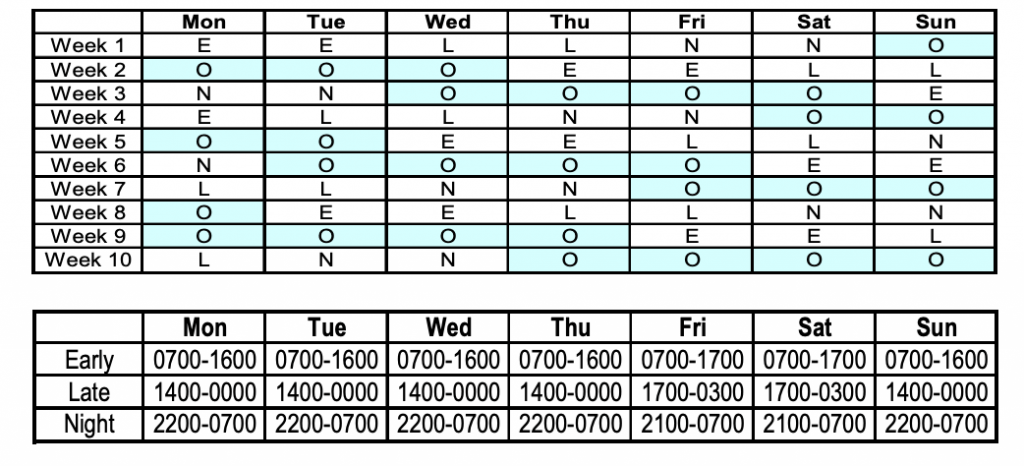
Illustrative Example 2: 5-Week Divisional Variable Shift Roster
Some urban response divisions (such as Edinburgh) have operated a 5-week variable shift cycle built around alternating blocks of 3 and 4 shifts followed by 2 or 3 rest days (for example, 4 night shifts → 3 rest days → 3 back shifts → 2 rest days → 4 early shifts → 2 rest days → 3 night shifts). Across the 5-week cycle, an officer typically works three out of five weekends while receiving extended rest periods after night shifts.

Typical Shift Handover Times
Although start and finish times are staggered between teams so an entire station does not change over at the exact same minute, typical response shift windows look like this:
- Early shift (Day shift): typically starts around 07:00 and finishes around 16:00 or 17:00.
- Back shift (Late / Afternoon shift): typically runs from 14:00 to 00:00 on weekdays, often shifting later (e.g. 16:00 to 02:00 or 17:00 to 03:00) on Friday and Saturday nights.
- Night shift: typically starts at 21:00 or 22:00 and finishes at 07:00 the next morning.
Do Police Scotland Officers Get Paid Overtime?
Yes. Police Scotland officers below the rank of Inspector are entitled to paid overtime (or can elect to take Time Off in Lieu, known as TOIL) whenever operational duties require them to work beyond their rostered 40-hour working week.
In frontline response policing, you cannot simply walk away from an ongoing incident when your shift is due to end. Processing a late custody arrest, guarding a locus (crime scene), taking urgent witness statements, or attending court frequently extends a shift. According to figures released under Freedom of Information, Police Scotland officers worked 1,074,545 hours of overtime in 2021/22—accounting for 3.1% of all hours worked across the force that year.
How Police Scotland Overtime and Rest-Day Pay Work
- Unplanned / casual shift extensions: When you are kept on duty past the end of your rostered shift, overtime is calculated in 15-minute increments and paid at time and a third (1.33x) of your pensionable hourly pay rate (under Police Service of Scotland regulations, the first 30 minutes of casual overtime on the first four occasions in a week may be disregarded for casual extensions, so check current Scottish Police Federation guidance for exact claiming rules).
- Working into a rest day after a night shift: When a night shift overruns into the start of your rostered rest days, or when you are recalled to duty on a rest day, enhanced rest-day compensation rates apply.
- Cancelled rest days and public holidays: If a rostered rest day is cancelled with less than 15 days’ notice (for example, to policing major sporting fixtures, summits, or public order deployments), officers are compensated at time and a half (1.5x), and work required on a public holiday or with short notice attracts up to double time (2x) or re-rostered rest days.
2026 Constable Salary, Annual Leave & Work-Life Balance
Your basic salary is paid on the national Police Scotland Constable pay scale regardless of which division or shift pattern you work, with overtime paid on top of your basic rate. From 1 April 2026 (PNBS Circular 2026-01), constable pay is:
- On appointment (including initial training): £34,001 a year
- After 1 year of service (Pay Point 1): £36,995 a year
- After 2 years of service / end of probation (Pay Point 2): £39,988 a year
- Top of the Constable scale (Pay Point 11): £54,597 a year
Annual Leave, Flexible Working and Family Life
Working nights and weekends takes adjustment, but Police Scotland’s shift structure and benefits package include several features designed to protect work-life balance (Police Scotland, Rewards and benefits, checked 13 October 2026):
- Rest-day blocks and annual leave: Because response shifts are grouped into blocks followed by 3 or 4 rest days, booking annual leave across a single 6-day tour of duty combines with the rest days on either side to give you up to 14 consecutive days off.
- Flexible working options: Officers can apply for part-time working or compressed hours under Police Scotland’s flexible working policy.
- Parental leave and career breaks: Full maternity, paternity, adoption, and shared parental leave schemes, plus the option to apply for an unpaid career break of up to five years.
- Wellbeing and pension: Automatic entry into the career-average police pension scheme (with a pension age of 60), Occupational Health support, a 24/7 Employee Assistance Programme, and access to the Police Treatment Centres.
Frequently Asked Questions
What shift pattern does Police Scotland use?
Police Scotland does not publish a single fixed shift pattern for the entire force because rosters vary by local policing division, urban versus rural demand, and department. In frontline response policing, officers commonly work Variable Shift Arrangements (VSA) of 9- to 10-hour shifts—such as the illustrative 2-2-2 pattern (2 earlies, 2 back shifts, 2 night shifts, followed by 4 rest days) or a 5-week rotating roster—averaging 40 hours per week.
Do Police Scotland officers get paid overtime?
Yes. Police Scotland constables and sergeants get paid overtime (or can take time off in lieu) when they work beyond their rostered 40-hour week. Casual shift extensions are calculated in 15-minute increments at time and a third (1.33x), while cancelled rest days and public holiday working attract enhanced rates of time and a half (1.5x) up to double time (2x) depending on notice.
What hours do you work during Police Scotland initial training?
During your 18-week initial training programme—which includes 15 weeks at the Scottish Police College at Tulliallan or the Training and Recruitment Centre in East Kilbride—you generally work structured weekday hours (Monday to Friday). You move onto a 24/7 rotating response shift pattern once you join your local division for your two-year probationary period.
Can you work part-time or flexible shifts in Police Scotland?
Yes. Under Police Scotland’s rewards and benefits framework, officers can apply for part-time working and compressed hours, as well as maternity, paternity, adoption, and shared parental leave, and unpaid career breaks of up to five years.
Do Police Scotland officers get paid extra for night shifts?
Unlike some civilian sectors, routine rostered night shifts are factored into a police constable’s basic pensionable salary (£34,001 on appointment rising to £54,597 from 1 April 2026) rather than carrying a separate hourly night-shift premium. However, if a night shift overruns into a rostered rest day, overtime and rest-day compensation rates apply.
Sources: Police Scotland — Rewards and benefits; Police Scotland — Apply to become a Police Officer; Police Negotiating Board for Scotland (PNBS) Circular 2026-01 (February 2026); Police Service of Scotland Regulations 2013. Last checked 13 October 2026.
Realistic mock exams in Language, Numeracy and Information Handling with complete explanations.
Police Scotland Free Practice Paper 2025

Police Scotland Application Form Guide: Questions, CVF & Examples (2026)
