
If you are worried that you are too short or too tall to join Police Scotland, you can stop worrying now. Height is not a selection criterion in modern police recruitment, and no published Police Scotland requirement sets a figure in feet, inches or centimetres.
That answer raises a second question, which is the one that actually matters for your application: if height is not measured as a pass or fail, what is? Below you will find what the medical assessment checks, where BMI fits in, what the fitness test demands, and why blanket height rules disappeared from police recruitment in the first place.
Is there a height requirement for the police in Scotland?
No. While UK police officers are no longer subject to a minimum or maximum height requirement, Police Scotland does not publish a specific height threshold. Police officers in the UK are no longer subject to a minimum or maximum height requirement, so no minimum height is required for police applicants and there is no upper height limit for police candidates.
Put the three common versions of the question side by side and the answer does not change. Is there a minimum height for police? No. Is there a height restriction for police officers? No. Is there a height requirement to be a cop? The slang differs, the position is identical.
One caveat on scope, because precision matters here. The clearest modern statement that UK police officers face no minimum or maximum height requirement comes from legal commentary on European discrimination law rather than from a Police Scotland recruitment notice. Police Scotland publishes eligibility criteria covering matters such as driving licence endorsements and financial standing, and it does not publish a height threshold, which is consistent with height simply not being part of the assessment.
How tall do you have to be to be a police officer?
Any height. There is no figure to hit, no range to fall inside, and no advantage given to taller candidates at any stage of the process. What is assessed is whether you can meet the standards that are actually published: the entrance test, the fitness test, the medical assessment, the interview and vetting.
That distinction is the whole point. Height is a fixed physical characteristic you cannot train. The published standards are things you can prepare for, and they are the ones that decide whether your application progresses.
Is there a different height requirement for a police officer who is a woman?
No. Because there is no height requirement for police officers at all, there is no separate figure for women and no separate figure for men. Historically, UK forces operated fixed minimum height thresholds (such as 5 ft 10 in to 5 ft 11 in in the 1966 Parliamentary debates), and equality law later challenged uniform physical cut-offs where they disproportionately excluded women.
Historical recruitment pages may mention different minimums for men and women, but these figures are not part of current Police Scotland eligibility criteria. They are not part of today’s Police Scotland eligibility criteria.
What the 1966 height debate actually recorded
The height question has a documented parliamentary history, and it is worth seeing what it really says. In the House of Commons on 4 August 1966, Mr Brian Parkyn asked the Home Secretary when regulations would require police forces to abandon recruit height restrictions of 5 ft 11 in, 5 ft 10½ in and 5 ft 10 in, and adopt a standard 5 ft 8 in instead, in order to help reduce the manpower shortage in the police forces of England and Wales.
Replying for the government, Mr Taverne said that “most of the forces with a serious manpower problem already recruit men of 5 ft. 8 in.” He added that the matter would be reviewed once the Working Party on Manpower, set up by the Police Advisory Board for England and Wales, had reported, and that “the question of height will be considered at the end of the year”.
Mr Parkyn pressed the point by noting that convictions for indictable offences had fallen to 39.2 per cent, compared with more than 50 per cent before the war, and asked for urgency in bringing forces up to full complement.
Two things follow from that record. The first is that a height restriction was treated even in 1966 as an obstacle to recruitment rather than a measure of competence. The second is a scope limit you should keep in mind: the Hansard exchange concerned police forces in England and Wales. It is historical context, not evidence of any past or present Police Scotland threshold.
Why blanket height requirements became a legal risk
The modern legal reasoning came from the European Court of Justice. In Ypourgos Esoterikon v Kalliri, the ECJ considered a Greek rule requiring police officers to be at least 1.7 metres tall, around 5 ft 7 in in old money. Ms Kalliri was rejected from the Greek police because she fell two centimetres short of that minimum.
She argued indirect sex discrimination, on the basis that women are generally shorter than men, so a universal height criterion disadvantages female applicants disproportionately. The European Court of Justice agreed that the rule amounted to indirect sex discrimination.
The justification test is the part worth understanding. As under UK legislation, indirect discrimination can be objectively justified where the provision, criterion or practice is a proportionate means of achieving a legitimate aim, or in the words of the EU Directive, “appropriate and necessary”. Ensuring officers are physically capable can be a legitimate aim. A single minimum height figure was not accepted as a proportionate means of reaching it.
That is why blanket recruitment criteria are now treated with caution across police forces. A rule that applies to everyone, but filters out one group far more heavily, needs a compelling justification and evidence that no less discriminatory method of selection exists.
Height is not a substitute for physical aptitude
The practical lesson from the ECJ case is straightforward: measuring a protected attribute is not the same as measuring ability. The commentary on the judgment put it bluntly as advice to employers: “Do not rely on general assumptions about physical (or mental) ability when devising recruitment selection criteria.”
A physical aptitude test is a better measure of a candidate’s suitability than a tape measure. It assesses what the job actually demands rather than what a recruiter assumes a capable officer looks like. The same analysis also noted that several policing functions, traffic control among them, do not call for significant physical force at all.
There is a condition attached, and it is important. Any aptitude test used in place of a blanket height criterion must itself be non-discriminatory. Replacing one crude filter with another achieves nothing.
BMI for police officers: what the medical assessment checks
Height does not disappear from the process entirely. It is recorded, but as an input rather than a verdict. The national police recruitment guidance for forces in England and Wales sets out what the medical assessment normally involves, and height sits inside a wider set of checks:
- height, weight and Body Mass Index (BMI)
- a musculoskeletal assessment
- blood pressure check
- urinalysis (urine test)
- spirometry (lung capacity test)
- hearing and eyesight checks
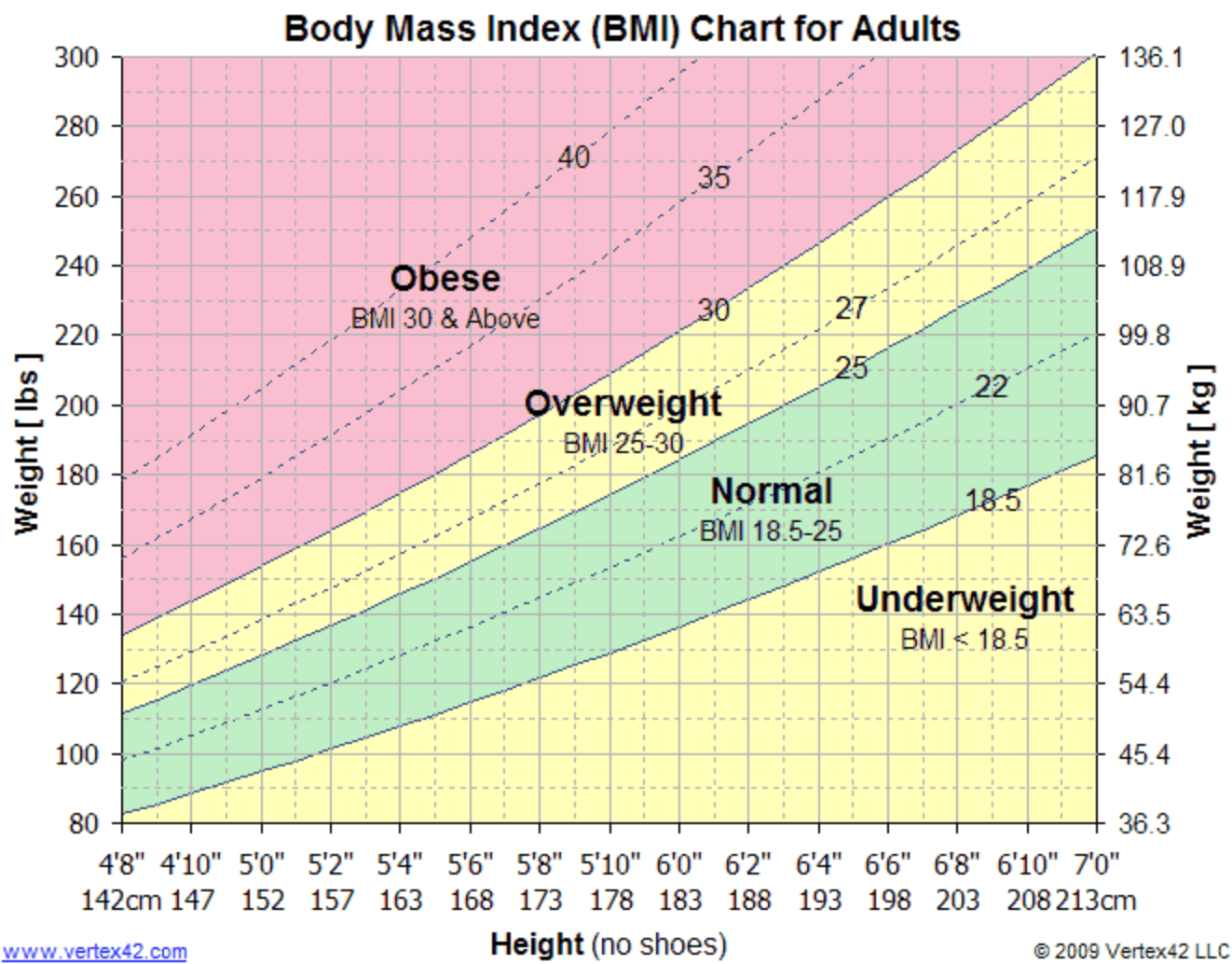
Note what that list does and does not say about BMI for police applicants. BMI is measured, because it combines height and weight into a single indicator. No universal minimum or maximum BMI figure is attached to it in that guidance, and it is presented as one measure among several rather than a standalone pass mark. If you have seen a specific BMI range quoted elsewhere, check it against current Police Scotland material before treating it as a rule.

The chart above shows how height and weight combine into a BMI figure, which is useful for orientation. Use it to understand where you sit, not as a published recruitment threshold.
Health conditions, documentation and reasonable adjustments
An existing health condition is not an automatic bar. Asthma or diabetes, for example, does not stop you becoming a police officer if you are fit and well and the condition is well managed. That is also the honest answer to “can I be a police officer if I’m skinny”: there is no standalone rule about being slight, only a medical assessment that looks at the whole picture.
Documentation matters too. Most forces require a completed health questionnaire signed by your GP, covering your current and past physical and mental health history, alongside a confidential health declaration. Fill it in carefully and early, because gaps slow applications down.
If you need support to perform at your best, you can request reasonable adjustments during the process. Asking for reasonable adjustments is a normal part of recruitment, not a mark against you.
The fitness test for Police Scotland
This is the stage where physical capability is genuinely assessed. Police Scotland uses a multi-stage shuttle run on a 15-metre track, and the passing standard is level 5.4. The distance between the markers and the required level are the same for every candidate, regardless of height or build.
Preparation is what moves the needle here. Shuttle running is a skill as much as a fitness measure, and practising the turn technique on a measured 15-metre course pays off. The fitness test also reappears later: Police Scotland has confirmed a further three fitness tests scheduled in later stages of the training programme, so the standard is something to maintain rather than peak for once.
Initial training itself runs for 18 weeks, made up of one week at a regional training centre, 15 weeks at the Scottish Police College or a Training and Recruitment Centre, and a final two weeks back at a regional centre.
Height is only one of several eligibility checks
Since height is not assessed, focus your attention on the criteria that are. Police Scotland publishes clear automatic rejection grounds: more than 6 points on your driving licence, or defaulted accounts totalling £1,000 or more. Both are worth checking before you apply rather than after.
The rest of the process follows the standard sequence of entrance test, assessment, fitness test, medical assessment, interview and vetting. If you want the full sequence in order, our guide to the Police Scotland recruitment process walks through each stage, and the step-by-step overview of how to become a police officer in Scotland covers what to prepare at each point. Candidates asking about academic entry requirements should also read whether a degree is needed for Police Scotland.
Frequently Asked Questions
What is the minimum BMI requirement for police officers in the UK?
BMI is checked, but no minimum BMI figure is set out in the national police recruitment guidance. BMI appears as one element of a wider medical assessment that also covers musculoskeletal health, blood pressure, urinalysis, lung capacity, hearing and eyesight. For reference, Police Scotland’s page for former officers rejoining the service states that BMI should be between 18 and 30, and the final-stage medical for applicants includes a BMI check.
What’s the minimum height for police?
There isn’t one. Police officers in the UK are no longer subject to a minimum height requirement. Police Scotland’s published eligibility criteria do not include any height rule either.
What’s the minimum height for a cop?
Same answer, different wording. There is no minimum and no maximum height requirement for UK police officers. Police Scotland’s eligibility list does not set one either.
Can a person with dwarfism join the police?
Height alone is not identified as a bar to UK police recruitment, since no minimum or maximum height requirement applies. The medical assessment and fitness test still apply in the normal way, and those stages assess capability rather than stature.
Can I be a police officer if I’m skinny?
There is no standalone rule about being slight. Weight and BMI are recorded alongside musculoskeletal health and the other medical checks, and a well-managed health condition is not automatically a bar to recruitment.
Did there used to be a height requirement for UK police?
Yes, historically. A Hansard record from 4 August 1966 shows police recruit height restrictions of 5 ft 11 in, 5 ft 10½ in and 5 ft 10 in being debated, along with a proposed standard of 5 ft 8 in to ease the manpower shortage. That debate concerned England and Wales and is historical context only, not a current Police Scotland rule.
How is height checked during a police medical assessment?
Height is measured alongside weight and used to calculate BMI. The same medical assessment normally includes a musculoskeletal assessment, blood pressure check, urinalysis, spirometry, and hearing and eyesight checks, plus a confidential health declaration and a GP-signed health questionnaire.
Does height determine whether someone is suitable for police recruitment?
No. Legal analysis of the ECJ ruling on police height criteria concluded that a physical aptitude test is a more appropriate way to assess suitability than a protected attribute such as height. In practice, height is one recorded measurement among many, while the fitness test and medical assessment do the real work.
What to do next
Height is settled: it will not keep you out, and it will not get you in. The stages that decide your application are the entrance test, the fitness test and the medical assessment, and all three reward preparation.
Start with the written stage, because it comes first and filters hardest. Sit a realistic practice paper under timed conditions and see where you stand: take the free PSET practice test. Then build your shuttle running around the 15-metre track and level 5.4 standard so the fitness test is a formality rather than a gamble.
Sources
Realistic mock exams in Language, Numeracy and Information Handling with complete explanations.
Police Scotland Intake Dates 2026: Months, Numbers and Timing
Apply for Police Scotland: Eligibility, PSET and Process